

Compost turning is often treated as an independent process when selecting equipment—evaluating factors like daily processing capacity, turning depth, and travel speed. However, the specific granulation line that will ultimately process the fermented material dictates the precise level of uniformity required. While windrow turners and Large Wheel Compost Turner operate on similar principles, the downstream requirements—whether for bio-organic fertilizer disc granulation, dry extrusion granulation, or organic-inorganic blending—differ significantly regarding the moisture content, particle fineness, and degree of maturity (decomposition) of the fermented material.
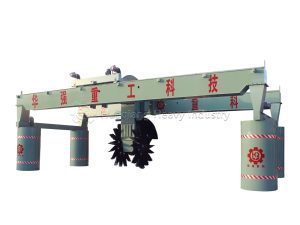
When the process feeds into a bio-organic fertilizer disc granulation line, “uniformity” primarily refers to the consistency of temperature and moisture. Since the process involves organic materials containing functional microorganisms, the temperature throughout granulation must generally remain below 55°C. The material entering the granulator should have a moisture content of approximately 25%–35% and a fineness of 60 mesh or higher. If the turning depth is insufficient or the equipment moves too quickly, some parts of the compost pile may remain incompletely decomposed or have an excessively high moisture content. Once this material enters the disc granulator, it can cause sticking on the disc surface and reduce the granulation yield. A more insidious issue is that incompletely decomposed material may continue to ferment and generate heat during storage, potentially raising local temperatures and threatening the survival of the functional microorganisms. Windrow turners are well-suited for small-to-medium-scale windrow composting, while large wheel compost turner are better adapted for large-scale, in-vessel (trough) composting, offering greater turning depth. In both cases, it is essential to ensure that material from the core and the edges of the pile is brought to the surface; otherwise, an “average” level of decomposition may mask pockets of raw, undecomposed material.
When the process feeds into a dry extrusion granulation line, the focus of uniformity shifts to the stability of moisture content. Dry extrusion granulation technology requires the input material to have a stable, relatively low moisture content and strictly controlled particle fineness. If the fermented material is excessively wet in certain areas, it leads to higher energy consumption during the subsequent drying phase. Furthermore, during the compaction (briquetting/granulation) process, such material can cause the roller surfaces to slip or experience material adhesion, resulting in loose, friable briquettes and an increased volume of recycled material (fines/rejects). What might appear as “acceptable on average” but “locally too wet” due to uneven windrow turning is, in reality, amplified within the compaction line, manifesting as excessive material recycling and accelerated wear on the roller surfaces. Therefore, when managing windrow turning for a process that feeds into a compaction line, the focus should be on the uniformity of moisture distribution throughout the pile, rather than simply maximizing the depth of the turning process.
If the material is destined for a bulk-blend (BB) fertilizer production line, the requirement for uniform turning must be viewed through the lens of “physical compatibility of organic granules.” BB fertilizer production lines and mixers are designed to handle finished fertilizer granules; they cannot process wet, fermented organic material directly. When producing organic-inorganic blended fertilizers, the fermented organic material must first be granulated before entering the BB blending process. In this context, the particle size, moisture content, and mechanical strength of the organic granules must closely match those of the urea and potash components. Otherwise, even with a highly precise multi-silo, single-weigh static batching system, the components will inevitably segregate after mixing. Uneven windrow turning causes fluctuations in the moisture content of the organic material, leading to inconsistent granule strength—which, in turn, becomes the root cause of segregation in the final blend.
A windrow turner should not be considered an isolated piece of equipment. The downstream granulation process must be defined first; only then can the required turning depth, uniformity, and moisture control parameters be determined. This ensures that the fermented material is truly suitable as a “feedstock” for the subsequent production stages.