

Q: What ensures the accuracy of the BB fertilizer production line?
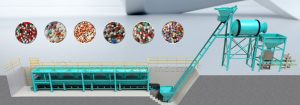
The core of BB fertilizer (blended fertilizer) production lies in “accurate batching.” The entire NPK Blending Fertilizer Production Line operates in an automated closed-loop system encompassing “storage – metering – conveying – mixing – packaging.” The accuracy of batching directly determines whether the nutrient content of the finished product meets standards, and the key to ensuring accuracy lies in the multi-bin single-scale static batching system. This system statically weighs each raw material one by one and then conveys the aggregated batches, unaffected by fluctuations in conveyor belt speed. The batching error can be controlled within ±0.2%. The multi-bin single-scale static batching system is simple to maintain – it has no complex moving parts; daily maintenance only requires cleaning the inner wall of the weighing hopper and checking the airtightness of the pneumatic doors. If the pneumatic gate of the batching system malfunctions or the sensor is interfered with, the precision advantage of static batching will be lost. Therefore, the sensor must be calibrated with standard weights before each shift, and the scale volume must be cleaned regularly.
Q: Why is temperature a critical factor in bio-organic fertilizer granulation?
The core of bio-organic fertilizer is beneficial functional bacteria, which are sensitive to high temperatures. When the temperature exceeds 60℃, the survival rate of microorganisms begins to plummet. The bio-disk organic fertilizer machine uses the principle of material naturally rolling into spheres on an inclined disc, generating no mechanical heat throughout the process, and maintaining the material temperature between room temperature and 45℃. For core functional bacteria such as Bacillus subtilis, around 45℃ is the optimal temperature, with a microbial survival rate of over 90%. The bio-organic fertilizer equipment process requires that the carrier temperature be controlled below 50℃ after adding the microbial agent. Even if the microbial strain is preserved during the granulation stage, the subsequent drying stage is equally critical—the drying temperature of the product after disc granulation should be strictly controlled below 60℃. Low-temperature, high-volume drying technology can control the drying temperature below the survival temperature of the microorganisms, ensuring that the survival rate of the microorganisms is as high as 90% or more.