

For small-scale farms, family farms, and entrepreneurs new to organic fertilizer production, large-scale, high-investment production lines are often impractical. Small-scale organic fertilizer granulators, due to their relatively low investment threshold, small footprint, and relatively simple operation, have become the ideal choice for these users to achieve resource utilization of waste materials and produce organic fertilizer for self-use or small-batch commercial sales.
Investment Threshold: Small-scale disc and flat die extruders usually have the lowest investment threshold, while small-scale roller extruders have a slightly higher single-machine cost but may save on overall production line investment.
Footprint: Small-scale roller extruders and flat die extruders usually have a more compact footprint due to their shorter process flow.
Operation Difficulty: Roller extruders and flat die extruders are relatively easy to operate, while small-scale disc granulators require more experience in moisture control.
Raw Material Requirements: Roller extruders require dry powder; disc and flat die extruders use a wet process and have certain moisture requirements, but do not require strict drying.
Finished Product Characteristics: Disc granulators produce round, smooth granules; roller extruders produce high-density, hard, and regularly shaped granules; flat die extruders produce cylindrical granules.
Advantages and Disadvantages Assessment: For users with extremely limited budgets and certain requirements for granule appearance, small-scale disc granulators have an advantage. If the raw materials are dry or drying is to be avoided, small-scale roller extruders have advantages in energy consumption and process simplification. Small-scale flat die extruders offer an option for users seeking the lowest possible cost and cylindrical granules.
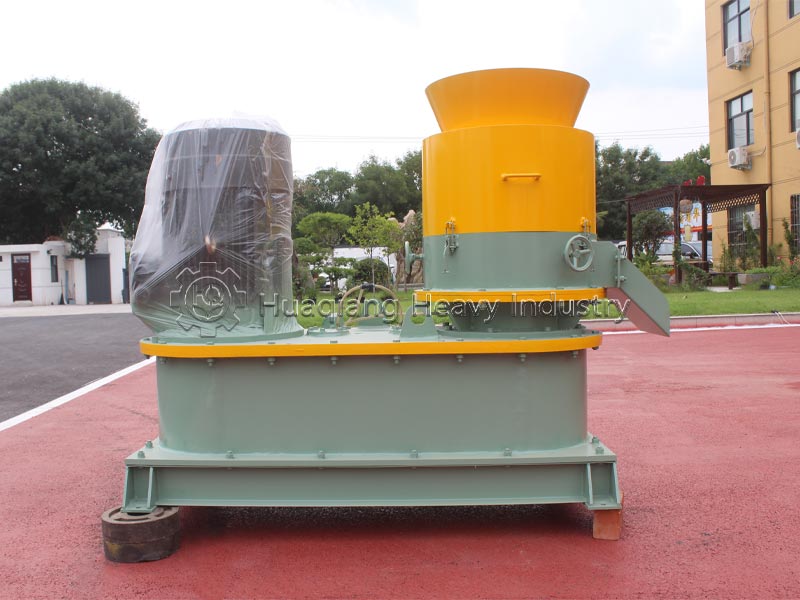
In addition to disc and roller extruders, there are also small-scale stirring granulators and flat die extrusion granulators on the market. For example, flat die extrusion granulators, similar in structure to feed pelletizers, extrude material through die holes using pressure rollers to form cylindrical granules, which are then cut. These devices also have the characteristics of simple structure and relatively low price, suitable for small-scale production where the shape of the granules is not critical (cylindrical is acceptable). They also have certain requirements for material moisture content.
The selection of a small-scale organic fertilizer granulator should focus heavily on “suitability.” For family farms or small-scale livestock farms aiming to process their own manure and produce a small amount of fertilizer for self-use, a small-scale disc granulator or flat die extruder is an economical choice due to its low initial investment and relatively simple operation. If the raw materials are controllable (e.g., ensuring proper dryness), and the goal is to produce high-quality, high-hardness granules, a small-scale roller press can significantly simplify the process and reduce post-processing costs. When choosing equipment, startups should consider not only the equipment itself but also the supplier’s after-sales service and experience with small-scale production lines.