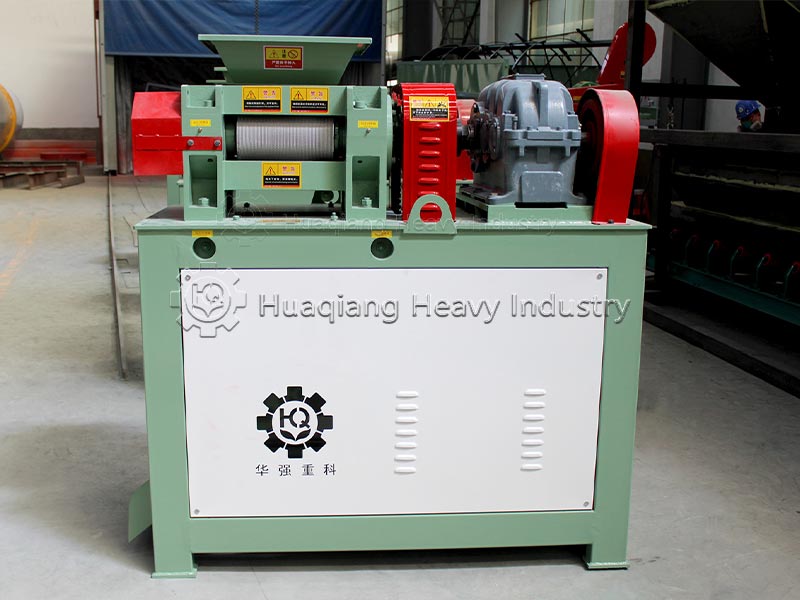

The relatively low energy consumption of double roller press granulator machines for processing NPK blended fertilizers is one of its core advantages compared to traditional wet granulation equipment, especially suitable for the energy-saving needs of large-scale NPK blending fertilizer production lines.
This equipment adopts a dry granulation process, directly extruding uniformly mixed NPK raw material powder into shape using mechanical high pressure. The entire process requires no additional drying step, while traditional wet granulation requires a large amount of thermal energy to dry the wet granules, a step that can account for more than 60% of the energy consumption of the entire production process. The power consumption of the roller press granulator is concentrated only in the roller shaft drive system. For small and medium-sized equipment, the energy consumption per ton of NPK blended fertilizer is usually less than 50% of that of wet granulation equipment; if large-scale roller press granulators are integrated with automated batching and conveying systems to achieve continuous, closed-loop operation, the unit energy consumption can be further reduced, lowering production costs.
However, energy consumption levels are also affected by raw material characteristics and operating parameters. If the NPK raw materials have high hardness, uneven particle size distribution, or the moisture content deviates from the optimal control range, it will increase the extrusion load of the equipment, leading to a slight increase in unit energy consumption. Conversely, if the raw materials are properly pre-treated and the moisture and particle size are precisely controlled, the equipment can maintain a stable, low-energy consumption operating state.
In summary, roller press granulators combine energy efficiency and high efficiency in NPK blended fertilizer processing, effectively reducing energy costs for fertilizer production enterprises and aligning with the industry trend of green manufacturing.