

The biggest challenge in organic fertilizer production is not equipment selection, but the state of the material. Raw materials such as livestock manure and crop straw generally have a moisture content of 60% to 80%, making them unsuitable for granulation in any granulation equipment. The first half of the entire production line essentially focuses on one thing—transforming high-moisture materials into “raw materials” suitable for granulation.
Turning the compost is the starting point, not the end point. Aerobic fermentation is the process of reducing moisture content, killing pathogens, and stabilizing organic matter. Fertilizer turning equipment accelerates moisture evaporation and organic matter decomposition by turning the material at the bottom of the compost pile to the surface and introducing fresh air into the interior. The frequency and depth of turning determine the fermentation efficiency—insufficient turning depth keeps the core of the compost in an anaerobic state for a long time, prolonging the fermentation cycle and reducing the effectiveness of water removal.
Fermented materials still require further processing. Even after thorough fermentation, the material’s moisture content remains at 30%–40%, far exceeding the 25%–35% requirement for granulation. In this case, it needs to be adjusted through sun-drying, pre-drying, or the addition of dry additives. For materials with high moisture content, a semi-wet material crushing process can be added before granulation to break up the clumps of fermented material and promote even moisture distribution.
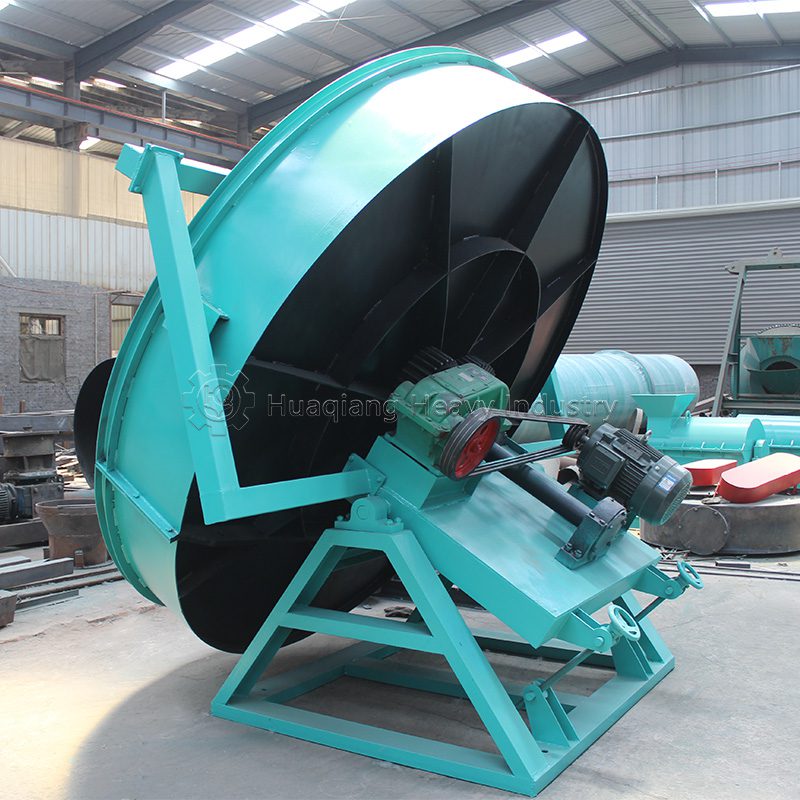
Granulation is crucial for forming the pellets, but it’s not the only determining factor. Disc granulators use a room-temperature physical forming process, where the material rolls on the disc to form pellets, achieving a pelleting rate of over 93%. However, disc granulation has specific requirements for the moisture content and fineness of the input material—the moisture content must be controlled between 25% and 35%, and the fineness must reach at least 60 mesh. If the initial fermentation and crushing stages fail to provide qualified materials, even the best-performing granulator will not produce qualified pellets.
The value of the entire production line lies in its seamless integration. Fermentation and turning equipment solves the problems of material moisture and stability; crushing and mixing equipment solves the problems of fineness and uniformity; granulation equipment solves the problem of molding; and drying and cooling equipment solves the problem of storage. Each piece of equipment prepares “qualified” materials for the next process. What truly determines the quality of an organic fertilizer production line is not which piece of equipment is the most expensive, but whether the various links can be smoothly connected—ensuring that the materials are in the “right” state in each process.