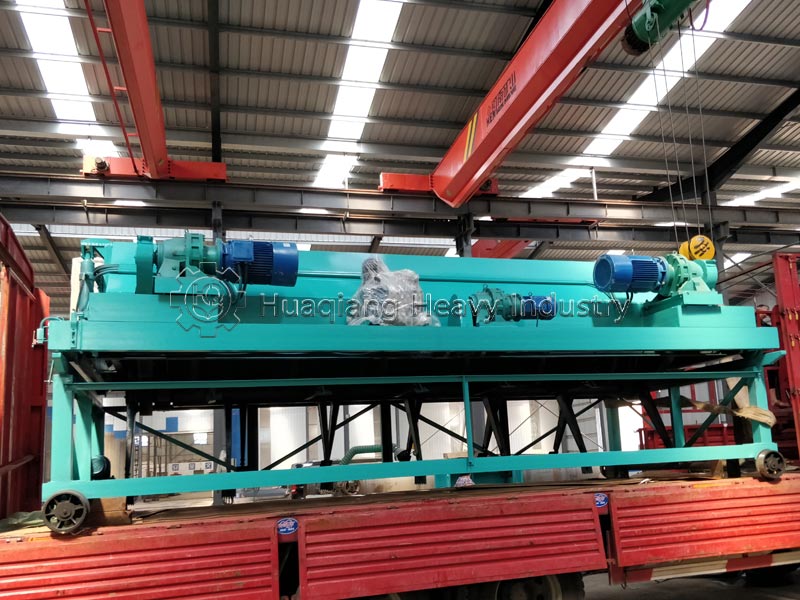

The hydraulic compost turning machines meets the aerobic fermentation requirements of a wide variety of organic materials—including livestock and poultry manure, crop straw, sewage sludge, kitchen waste, and spent mushroom substrate—by allowing for the flexible adjustment of operating parameters and structural configurations. This ensures that materials with varying characteristics undergo rapid maturation and uniform dewatering.
Adjusting the turning depth is the primary method for adapting to different materials. For materials with high moisture content and high viscosity—such as chicken manure and sewage sludge—the turning depth can be appropriately reduced to prevent material from adhering to the turning blades and to avoid excessive mechanical load. Through the stepless adjustment capabilities of the hydraulic system, the machine can quickly adapt to the specific fluffiness and pile height requirements of various material types.
Controlling the travel speed and turning drum rotation speed allows the machine to adapt to varying fermentation rhythms. For highly viscous materials prone to clumping, the travel speed can be reduced while increasing the drum rotation speed to ensure the material is thoroughly broken up and fully exposed to air. Conversely, for materials that ferment rapidly and possess high calorific value—such as cattle manure and kitchen waste—the travel speed can be appropriately increased to prevent excessive heat loss caused by over-agitation, while simultaneously preventing the pile from overheating and scorching.
Replacing or adjusting the structure of the turning blades allows the machine to accommodate differences in material properties. For fibrous materials prone to entanglement, wide-toothed blades can be selected to minimize winding and clogging. For materials with high moisture and strong viscosity, smooth, wear-resistant blades are preferred to reduce the likelihood of material adhesion. Furthermore, for materials containing a high proportion of impurities, the structural strength of the blades can be reinforced to enhance their durability.
Additionally, the equipment can be customized with specific span widths to match the dimensions of the fermentation trough and the required material processing capacity; when integrated with an automatic control system, it enables intelligent, automated turning operations. By comprehensively adjusting parameters such as turning depth, travel speed, blade configuration, and turning frequency, the hydraulic trough-type compost turner efficiently adapts to a wide spectrum of organic materials, ensuring thorough fermentation and stable operation while meeting the requirements for the harmless treatment and resource utilization of diverse raw materials.