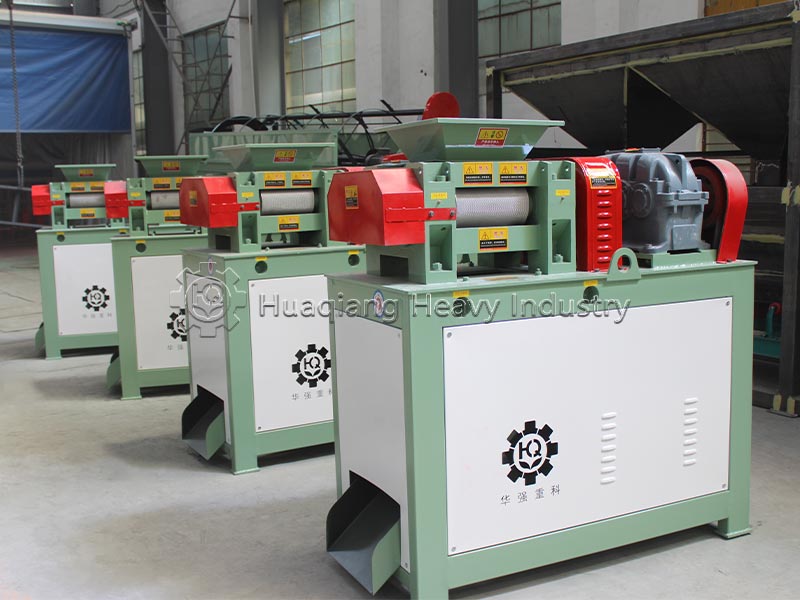

Improving the granulation uniformity of NPK blending fertilizer production lines revolves around five core aspects: raw material pretreatment, homogeneous mixing, granulation parameter control, classification and closed-loop control, and NPK bulk blending machine management. Precise control of key parameters is essential for efficient improvement.
Raw material pretreatment is fundamental. Fine powders and agglomerates must be screened out, and a double-roll crusher and 20-40 mesh vibrating screen should be used to control the raw material particle size difference to ≤5%. Density and angle of repose differences should both be <5°, and the moisture content before granulation should be stable at 2%-5%, preventing segregation and granulation difficulties from the source.
Homogeneous mixing is crucial. Small-proportion additives should be pre-mixed before entering the main mixer. Small and medium-sized lines should use a double-screw conical mixer, while large lines should use a gravity-free mixer. Control the loading rate at 60%-80% and mixing time at 5-8 minutes to ensure a nutrient variation coefficient (CV) ≤5%. Add flow guides and mixing devices at the discharge point to prevent stratification.
Granulation parameters require precise adjustment. Rotary drum/disc/double roller granulator machines should be matched to the corresponding capacity. Strictly control the rotary drum speed at 8-12 rpm and inclination angle at 3°-5°, and the disc speed at 10-15 rpm and inclination angle at 45°-55°. Atomized humidification should control the granulation moisture content at 3%-6%, and the binder should be sprayed evenly to ensure stable and dense particle formation.
A closed-loop classification system and post-production management are also necessary. Use 2-3 layers of sieves for multi-stage screening. Unqualified particles should be crushed and re-mixed. After cooling, the temperature should be ≤40℃, and after drying, the moisture content should be ≤1.5%. Regularly calibrate metering equipment and inspect nozzles and screens. Combine this with online monitoring for real-time parameter adjustment to form a stable production closed loop, which can effectively improve granulation uniformity by more than 30%.