

Rotary drum granulators are the most widely used type of fertilizer granulator in NPK fertilizer production lines. They offer advantages such as high capacity, rounded granules, mature technology, and easy operation and maintenance. Suitable for small and medium-sized NPK fertilizer production enterprises, their process principle and standardized operation directly determine the granulation qualification rate and finished product quality.
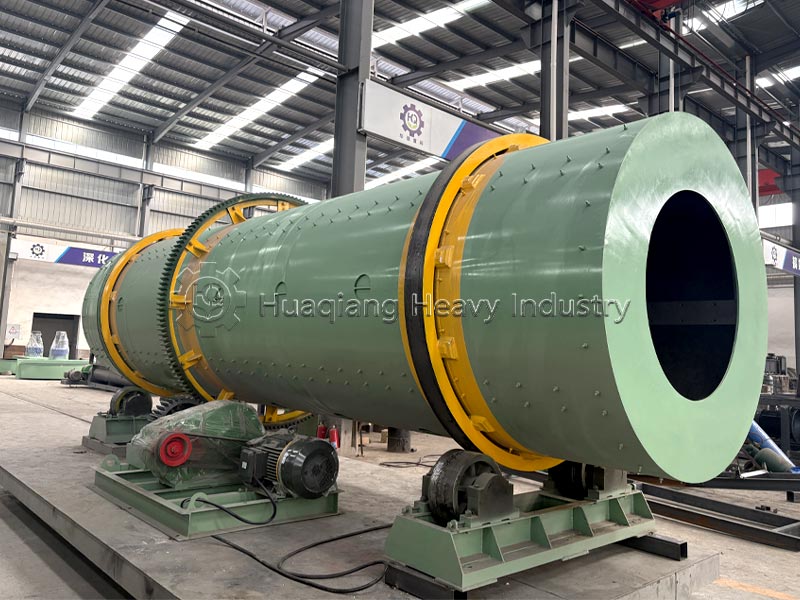
The core process principle utilizes the synergistic effect of mechanical force and heat: Driven by a motor, the drum of the rotary drum rotates at a constant speed at an inclination of 3°-5°. Pre-treated raw material powder and binder are fed into the drum in proportion. Using the centrifugal force, friction, and gravity generated by the drum’s rotation, the raw material powder collides and adheres to each other, gradually agglomerating into rounded granules with a particle size of 2-4mm. Simultaneously, hot air is introduced for drying to ensure the granule hardness meets standards. For NPK fertilizers with high organic content, the raw materials need to be fully turned and decomposed by a fertilizer turner to reduce fiber content and minimize wear on the rotary drum granulator liner.
Standard operation requires controlling four key parameters: drum speed (10-20 r/min), hot air temperature (100-120℃), and matching of feed rate and binder dosage. Common problems and solutions are clearly outlined: for particles that are too small, increase the binder dosage and decrease the drum granulator speed; for particles that are too large or clump together, reduce the feed rate and increase the hot air temperature; for particles that are not hard enough, extend the drying time and fine-tune the drum tilt angle. Proper operation and timely adjustments can ensure a granulation qualification rate of over 95% for drum granulators in NPK fertilizer production lines.