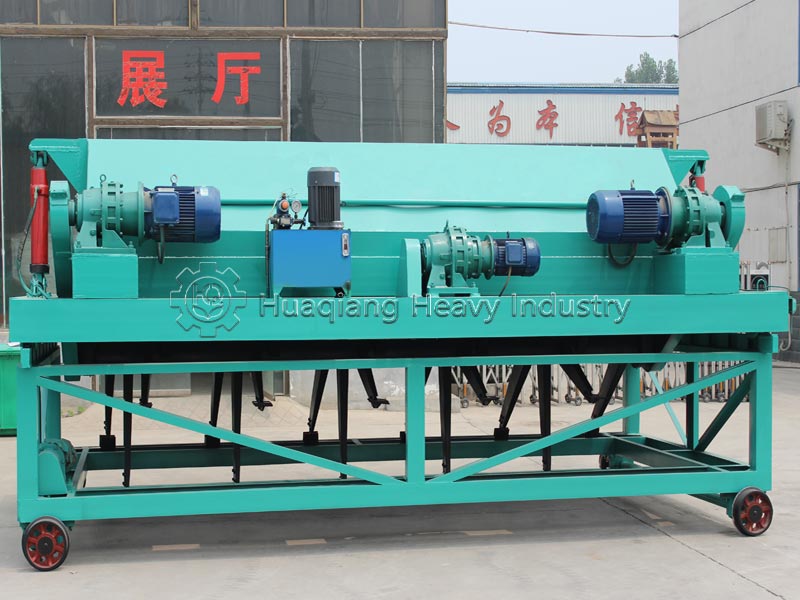

Uneven turning in hydraulic compost turning machines directly leads to uneven material levels and oxygenation within the fermentation tank, affecting the speed and quality of organic fertilizer composting. The main causes are concentrated in four areas: equipment, operation, materials, and foundation conditions.
Inappropriate equipment parameters are the primary cause. Excessively fast or slow turning drum rotation speed will result in uneven material distribution; inconsistent hydraulic lifting height will cause uneven turning depth on both sides, resulting in one side being deeper than the other. Severely worn, detached, or inconsistently angled drum blades will lead to asymmetrical material conveying and spreading, resulting in a pile that is higher in the middle and lower at the sides. Uneven tension in the travel reducer, sprockets, and chains, or asynchrony on both sides, will also cause the equipment to deviate from its path, exacerbating uneven turning.
Improper operation of the organic fertilizer fermentation production line also affects uniformity. Uneven material piles, with varying heights and thicknesses, make it difficult to achieve uniform turning even with standardized equipment. Fluctuating travel speeds and frequent starts and stops can cause localized repeated turning or missed turning. Frequent adjustments to the turning depth, without maintaining a constant level, result in insufficient turning of the bottom layer, creating anaerobic zones.
Inadequate material pretreatment also causes problems. Large differences in material moisture content, lumps, and the presence of long straw or impurities can lead to uneven pressure on the rollers and disordered material throwing. Large pieces of material and hard lumps can obstruct normal turning, causing localized accumulation.
Foundation and track issues cannot be ignored. Uneven tracks, significant height deviations, and uneven wheel wear can cause the equipment to tilt. Frame deformation and loose limit switches can result in inconsistent contact surfaces between the turning rollers and the material, ultimately leading to poor turning throughout the trough and noticeable unevenness.