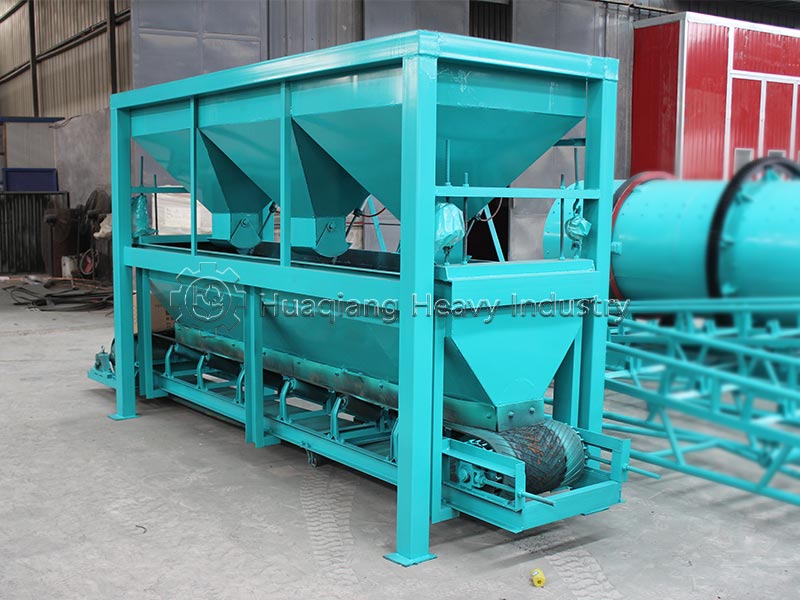

The core technological features of the NPK blending fertilizer production line are precise ingredient proportioning, homogeneous mixing, adaptable granulation/molding, and stable finished product grading. It allows for flexible switching between different NPK formulations, has a simple overall process, and its production capacity can be adjusted as needed. Specific core features are as follows:
1. Precise and controllable ingredient proportioning: Utilizing multiple silos single weigh static batching systems, it separately meteres nitrogen, phosphorus, and potassium fertilizers and additives, supports one-click formulation switching, and the proportioning error can be controlled within ±0.5%, meeting the ratio requirements of different concentrations of NPK blended fertilizers.
2. Highly efficient and homogeneous mixing: Equipped with specialized equipment such as horizontal twin-shaft paddle mixers, the mixing speed and time can be precisely adjusted. Materials form a seamless convection mixing process within the machine, avoiding stratification and achieving a homogeneity of over 95%, ensuring balanced fertilizer efficacy.
3. Strong Process Adaptability: The granulation process can be flexibly integrated or directly dry-mixed for packaging according to finished product requirements. It can produce both powdered blended fertilizers and granular NPK fertilizers, adapting to different market demands.
4. Balanced Production Continuity and Flexibility: Modular design of each process allows for fully automated continuous operation of feeding, batching, mixing, and packaging. Single-line capacity is adjustable from several tons to tens of tons per hour, and inventory clearance is convenient when changing formulas, eliminating cross-contamination.
5. Low Energy Consumption and Simplified Process: Compared to the melt granulation process for compound fertilizers, blended fertilizer production does not require high-temperature heating. It is completed solely through physical mixing/room-temperature granulation, significantly reducing energy consumption. With fewer process steps, NPK bulk blending machine has a low failure rate and low maintenance costs.