

In the field of fertilizer processing, there is a question that seems simple yet is rarely probed deeply: why is it that, given two bags of compound fertilizer, the granules in one might crumble into powder at the slightest pinch, while those in the other are hard enough to chip a tooth? The answer lies not in the nutrient formula, but in how the granules’ “physical identity” is established. NPK blending lines, double roller press granulators, and bio-disk organic fertilizer machines represent three distinct pathways for defining this physical identity: blending, pressing, and granulating.
The logic of “blending” is the most restrained. An NPK blending line deals with finished granules that already meet specifications; urea, diammonium phosphate (DAP), and potassium chloride arrive from upstream plants with their form, hardness, and particle size already standardized. The production line’s task is simply to weigh and mix them accurately according to the formula. While this sounds simple, the challenge lies in preventing segregation. With a bulk density of approximately 1.33 g/cm³ for urea and 1.98 g/cm³ for potassium chloride—a difference of nearly one-third—heavier granules naturally sink while lighter ones rise during mixing and gravity-fed transfer. Consequently, this line demands exceptional precision in ingredient dosing; static weighing systems must keep errors within a very tight range. Mixing relies on the gentle, low-speed convective motion characteristic of BB (Bulk Blend) fertilizer mixers, allowing granules of varying densities to repeatedly swap positions within the drum while minimizing breakage. The value of a BB fertilizer line lies not in creating something new, but in ensuring that every pre-existing granule ends up in the correct position.
The logic of “pressing” is entirely different. When raw materials are powders rather than granules, the double roller press granulator functions by “using pressure instead of moisture.” Two high-strength rollers rotating toward each other instantly compress dry powder materials into a dense sheet, which is then crushed and screened to produce granules. The core mechanism of extrusion involves reducing the distance between particles sufficiently to trigger intermolecular forces—such as van der Waals forces, adsorption, and crystal bridge bonding. The entire process requires neither added water nor a rise in temperature, and the raw material’s moisture content needs only to be maintained between 5% and 10%. By eliminating the drying and cooling systems essential to wet granulation, the production line’s energy consumption can be reduced by over 40%. The cross-sections of the extruded granules bear natural compression marks; while they may lack the perfect roundness of disc-granulated products, they possess high density and strength, making them particularly suitable for “delicate” formulations that are prone to deliquescence upon contact with water or melting when exposed to heat.
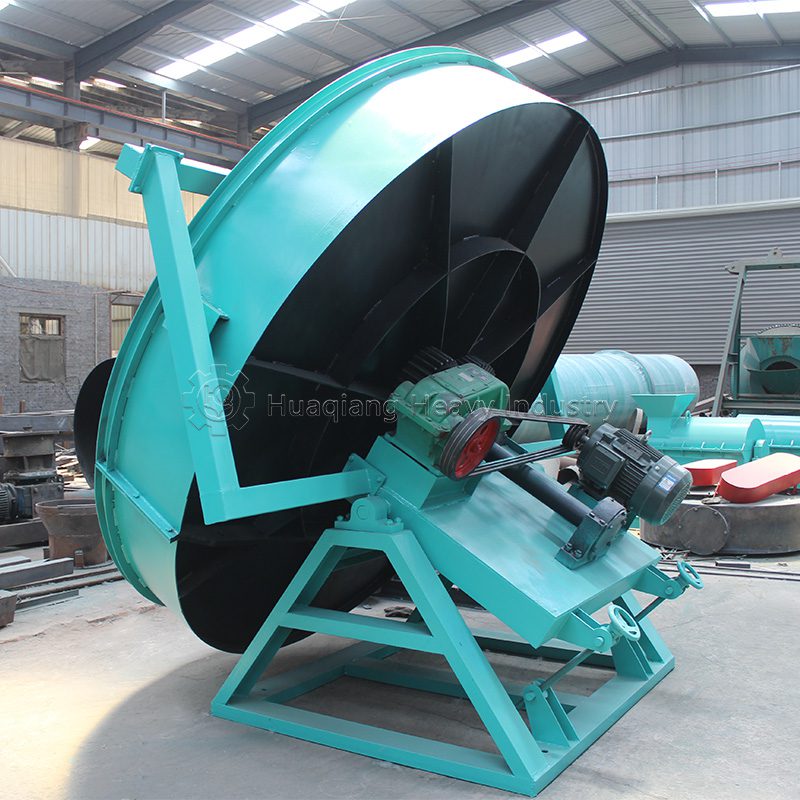
The logic behind this granulation method lies somewhere in between: it neither preserves the material’s original state nor relies on brute force, but rather “grows” the granules from scratch. Disc granulation systems process fermented, decomposed organic materials—substances often characterized by high moisture content, fibrous textures, and low bulk density—which are notoriously difficult to shape using other types of granulation equipment. Inside the tilted, rotating disc, materials tumble repeatedly under the combined influence of gravity, centrifugal force, and friction; fine powder particles gradually grow in size as they accumulate layers of atomized moisture. Precisely coordinating the disc’s tilt angle and rotational speed is key to controlling granule size; the tilt angle is typically adjustable between 35 and 55 degrees, while the rotational speed is inversely proportional to the disc’s diameter. Disc granulation yields uniform, spherical granules with smooth surfaces and a pelletization rate exceeding 85%, making it an ideal choice for organic and high-end horticultural fertilizers where visual appeal is a priority.