

In the world of fertilizers, particle size, hardness, and composition distribution are never trivial details. They determine whether nutrients can be successfully absorbed by crops, whether mechanized application is even, and even whether the soil becomes more fertile or less productive. When we look at the modern fertilizer processing field, we find that the three distinct production lines—NPK Blending Fertilizer Production Line, Bio Organic Fertilizer Production Line, and Disc Granulation Production Line—form a complete closed loop from “precision chemical nutrient supply” to “soil ecological restoration.” Each answers a fundamental question in agriculture: How exactly should we deliver nutrients to plants?
The essence of the NPK Blending Fertilizer Production Line lies in “formulation,” not “manufacturing.” This production line doesn’t aim to alter the chemical form of raw materials. Instead, like a chef skilled in ingredient proportions, it physically mixes nitrogen, phosphorus, and potassium (NPK) base fertilizers from different sources and with different particle sizes according to a predetermined formula. Its challenge lies in how to ensure that urea, as light as a feather, and phosphate rock powder, as heavy as fine sand, are uniformly mixed in a very short time. The answer lies in the convective motion of the twin-shaft paddle mixer—two counter-rotating shafts drive the paddles, creating a complex, parallel vortex of material within the drum. Particles with vastly different densities achieve statistical uniformity through continuous scattering and falling. The entire process is so gentle that it produces almost no dust, resulting in perfectly round, intact granules suitable for simultaneous sowing and mechanized application. The automatic batching scale embedded in the production line boasts an accuracy of a few ten-thousandths, ensuring that the NPK ratio in every ton of finished product strictly adheres to soil testing and formula data. This “physical compounding” approach perfectly meets the urgent need of large-scale farms for customized, specialized fertilizers.
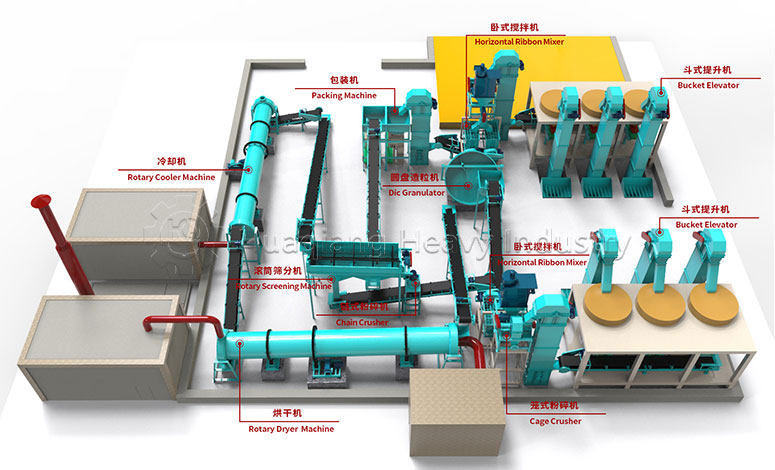
The bio-organic fertilizer production line addresses the deep-seated anxiety of “whether the fertilizer is good enough and whether the soil can withstand it.” The raw materials for this production line are not industrial chemicals, but agricultural waste such as livestock and poultry manure, crop straw, and distiller’s grains. These materials first undergo high-temperature aerobic fermentation. With regular disturbance by a turning machine, the pile temperature is maintained above 55°C for several days, sufficient to kill insect eggs and pathogens. Even after fermentation and decomposition, the material still has a moisture content of over 30%, making it highly susceptible to secondary mold growth if stored directly. This is where the disc granulation production line comes in to complete the crucial molding process. The working principle of the disc granulator is quite fascinating: a large, tilted, rotating disc tumbles the material inside, while atomizing nozzles replenish water as needed. The fine powder particles are layered and gradually grow larger during the rolling process, forming uniformly sized spherical particles like a snowball. This “wet pelletizing” method is particularly suitable for materials with high organic matter content and strong fiber content. The resulting pellets are round and full, and the disc inclination angle and rotation speed are adjustable to adapt to the pelletizing characteristics of different materials. After granulation, drying, cooling, and screening, the organic fertilizer pellets, when applied to the soil, significantly improve soil structure, provide a habitat for beneficial microorganisms, and fundamentally alleviate soil compaction and acidification problems caused by long-term chemical fertilizer application.
These three production lines together constitute a “nutrient toolbox”—inorganic fertilizer provides rapid supply, organic fertilizer provides long-term improvement, and the pelletizing technology gives all nutrients a physical shell that facilitates storage, transportation, and application.