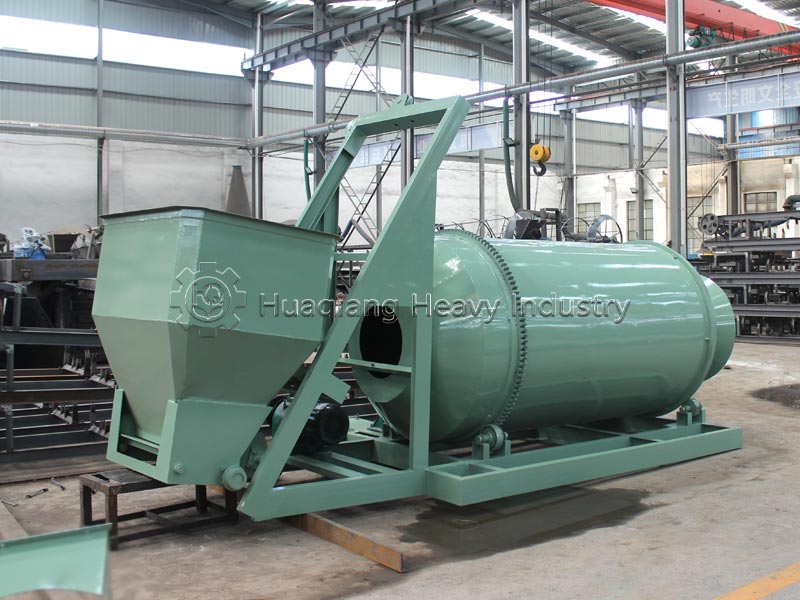

The technological innovations of the BB fertilizer mixer revolve around the core mixing needs of NPK compound fertilizer production lines, focusing on four core aspects: mixing precision, production efficiency, intelligent adaptation, and energy saving. It comprehensively adapts to the production characteristics of NPK compound fertilizer with multiple raw materials and ratios, becoming a key link in improving the overall efficiency of the production line.
In terms of mixing structure, the innovative model adopts a double-helix composite blade and arc-shaped end cap design, with a machine cavity gap of ≤5mm, eliminating dead zones and reducing material residue rate to below 0.5%. Combined with a low-speed forced mixing mode, the rotation speed is controlled at 20-35r/min, achieving a mixing uniformity of over 99% for NPK compound fertilizer particles of different sizes, while controlling the particle breakage rate to within 2%, ensuring the integrity of the finished particles.
Precise batching and metering upgrades are a core highlight for NPK compound fertilizer production lines. Equipped with a 6-compartment parallel metering system, the batching error is ≤±1%, allowing for flexible matching of raw material blending with different NPK ratios. A pre-treatment homogenization module optimizes raw material bulk density and moisture content, improving material flowability and preventing uneven mixing due to differences in raw material characteristics. This seamlessly integrates with the NPK compound fertilizer production line’s feeding process.
Intelligent control and digital operation and maintenance are deeply integrated into production line management. The PLC + IoT system monitors equipment operating parameters in real time, automatically adjusting stirring speed and time. It also links with the NPK compound fertilizer production line’s feeding and packaging systems to achieve full-process automation, reducing manual intervention and increasing production efficiency by over 30%. Furthermore, predictive maintenance functions use vibration and temperature monitoring to provide early warnings of malfunctions, reducing the risk of production line downtime.