

The core advantage of an NPK blending fertilizer production line lies in its flexible formulation, enabling the rapid production of specialized fertilizers of different specifications based on soil testing and formulation requirements. However, incomplete cleaning during formula switching can lead to cross-contamination, affecting the accuracy of nutrient content in the next batch.
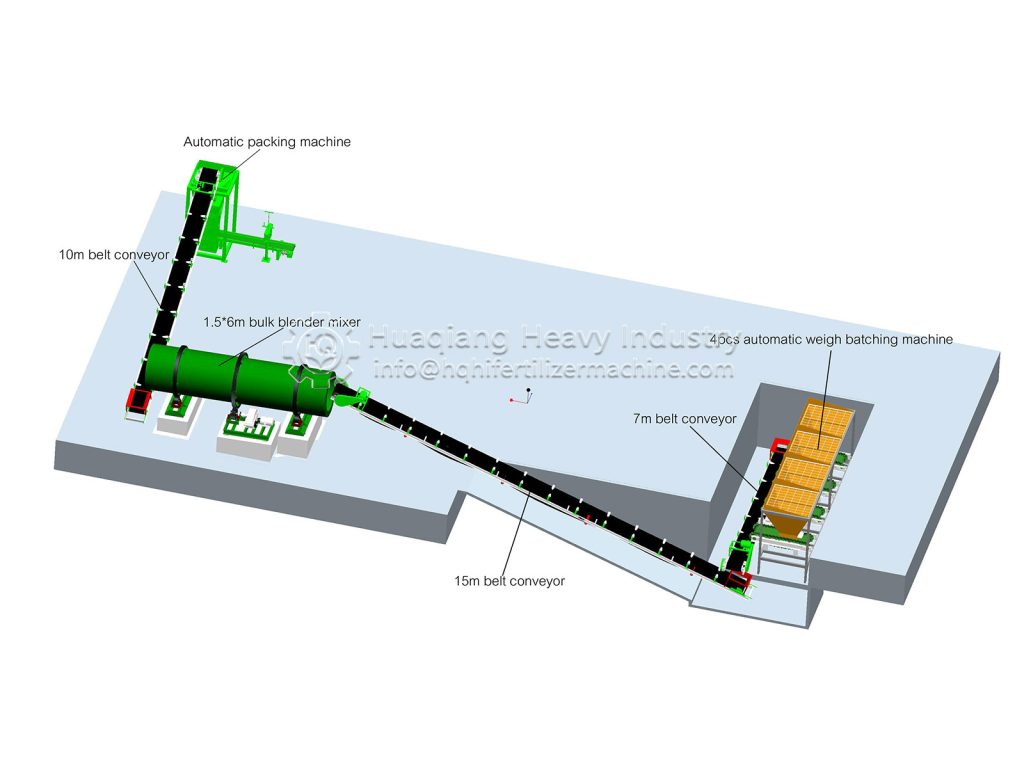
Key Challenges of Formula Switching: Different formulas have vastly different raw material combinations (e.g., switching from 15-15-15 to 28-6-6). Residual materials from the previous batch will alter the nitrogen, phosphorus, and potassium ratios in the new formula. Especially concerning are trace element residues; even small amounts can cause excessive nutrient deviations. Therefore, the efficiency and quality of formula switching directly depend on the thoroughness of cleaning.
Efficient Cleaning Strategies: First, the equipment design itself should facilitate cleaning—a high-quality NPK blender has a smooth, corner-free inner wall, ensuring clean unloading and minimal residue. Secondly, the “empty silo transition method” should be adopted in operation—before switching formulas, a small amount of the next batch of raw materials should be used to “wash” the silo once and then discharged to remove the residue from the previous batch. For automatic batching systems, the manual/automatic switching function can be used to thoroughly clean each storage silo and weighing hopper by opening its discharge port one by one.
Systematic Management: Establish a formula switching record log, recording the cleaning time, residue status, and initial inspection results for each switch. The batching system should support the storage and management of more than 20 formulas. During switching, only a preset formula needs to be called to automatically adjust the feeding ratio of each raw material. The entire production line adopts a modular layout, with batching accuracy reaching ±0.2% and mixing uniformity ≥95%, ensuring that the first batch of products meets the standards after formula switching. In addition, after switching, multiple sampling tests should be conducted on the first batch of products to confirm that the nutrient content deviation from the target formula is within the allowable range before entering continuous batch production.