

In the process of moving from the concept to the practice of soil testing and formula fertilization, the most crucial link has always been: how to transform the nitrogen, phosphorus, and potassium ratio on the soil test report into actual fertilizer in the bag. It involves no granulation, drying, or chemical reactions; instead, it relies on precise physical mixing to blend pre-granulated basic fertilizers according to the formula, automating the entire process from raw material intake to final packaging.
The NPK blending production line (also known as a BB fertilizer line) consists of four main modules: raw material storage and conveying systems, a high-precision batching system, mixing equipment, and an automatic packaging system. Once production begins, basic fertilizers—such as large-granule urea, monoammonium phosphate (MAP), and potassium sulfate—are transported via bucket elevators to their respective buffer bins. Variable-frequency screw feeders at the bin outlets then perform dynamic, cumulative metering based on the preset formula. Equipped with high-precision sensors and intelligent weighing control algorithms, the batching system keeps metering errors within ±0.2%. The system employs a two-stage feeding method—”fast feed” followed by “slow feed”—to ensure that the nutrient ratio of every batch precisely meets design specifications, thereby eliminating errors and batch-to-batch inconsistencies associated with manual blending.
After batching, the materials enter the mixing equipment. Mainstream models utilize double axis paddle mixers, where the two shafts rotate in opposite directions, causing the materials to tumble in three-dimensional space. The mixing process is gentle yet efficient, completing a batch in 3 to 5 minutes with a coefficient of variation for mixing uniformity kept below 5%. Upon completion, the mixture passes through a discharge hopper into the finished product bin, followed by weighing, filling, and sealing by an automatic packaging machine. The entire line features centralized PLC control, automating the workflow from batching and mixing to packaging; operators can monitor the entire system from a central control room, with a single shift requiring only one or two personnel to operate.
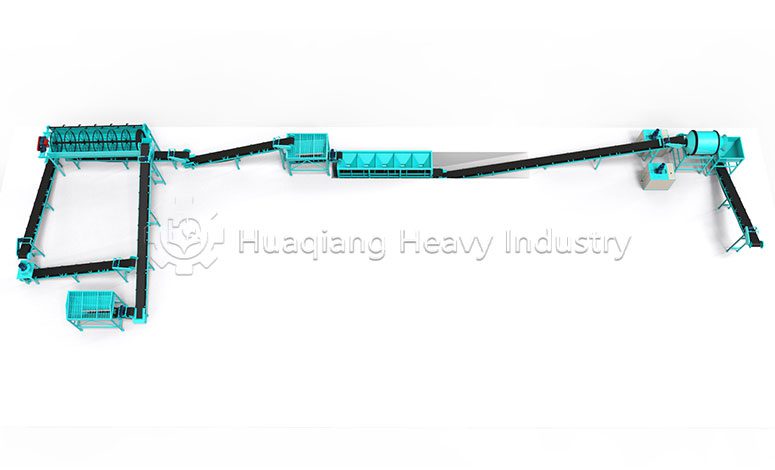
The greatest technical challenge facing NPK blending production lines is not the mixing process itself, but the prevention of segregation. The raw materials for BB (Bulk Blend) fertilizers consist of granules with varying densities and particle sizes; for instance, large-granule urea has low specific gravity and large particle size, whereas monoammonium phosphate (MAP) has high specific gravity and small particle size. In traditional mixing equipment, these granules are highly prone to segregation due to gravity differences during mixing and conveying, resulting in inconsistent nutrient distribution between the top and bottom layers within the packaging bags. Modern NPK blending production lines systematically address this issue through several design features: the blender employs a gentle convective mixing principle to achieve uniformity without crushing or breaking the granules; the discharge stage utilizes a single-bucket lift that deposits material directly into the packaging scale hopper, thereby avoiding the repeated segregation caused by multiple lifting cycles; and some high-end models are equipped with anti-segregation distribution mechanisms to ensure consistent granule distribution throughout the entire process from mixing to packaging.
Another major advantage of NPK blending production lines is the flexibility of formula switching. The PLC system can store dozens or even hundreds of formulas, allowing a single production line to manufacture products with various formulations within the same day. Switching formulas requires only a simple selection on the control panel; the initial bags produced after the switch serve as a purge batch, and normal production resumes once any residual material from the previous run has been fully cleared from the system.