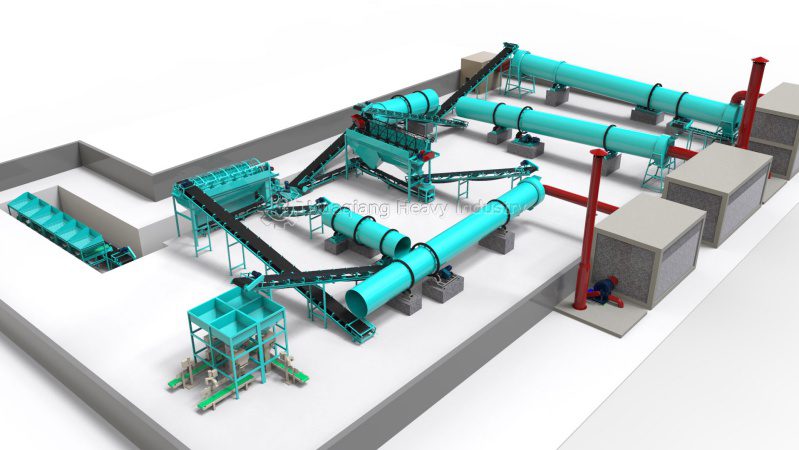

Improvements to the BB fertilizer mixer production process should focus on five core areas of optimization: mixing precision, wear resistance and service life, sealing reliability, operational stability, and intelligent control. This comprehensive approach aims to elevate both equipment quality and market competitiveness. The mixing structure is optimized through the adoption of a staggered dual-ribbon arrangement; by precisely engineering the pitch and blade angles, a strong convective circulation is generated, effectively eliminating mixing dead zones and maintaining mixing uniformity at a stable CV value of ≤3%, thereby meeting the rigorous blending standards required for BB fertilizers. Additionally, the installation of wall-scraping devices reduces material residue and enhances formula accuracy.
Wear-resistance technology is upgraded by applying a tungsten carbide hardfacing layer to working surfaces and equipping the mixing drum with wear-resistant liners—or constructing it from stainless steel—significantly boosting resistance to abrasion and corrosion, and extending the equipment’s service life. The sealing system is reinforced by employing a multi-stage labyrinth seal combined with a dust ring on the main shaft; this effectively prevents the ingress of dust and fertilizer particles, averting premature bearing failure and reducing maintenance frequency.
Transmission and machining precision are enhanced through the selection of national-standard motors paired with hard-toothed gear reducers, ensuring ample power and stable operation. The main shaft and mixing blades undergo precision machining and dynamic balancing calibration to minimize vibration and uneven wear, resulting in smoother operation for the entire BB fertilizer production line. The discharge structure is optimized through the use of pneumatic or hydraulic quick-opening gates, ensuring smooth, residue-free material discharge and boosting production efficiency.
Intelligent control capabilities are integrated via a PLC control system, enabling functions such as timed mixing, automatic discharge, formula storage, and fault alarms, thereby simplifying operation. Factory testing protocols are comprehensive, encompassing full-scale evaluations—including no-load, full-load, and mixing uniformity tests—to ensure that equipment performance meets all required standards. Through these process enhancements, a BB fertilizer mixer characterized by exceptional uniformity, wear resistance, and stability can be engineered, thereby strengthening the product’s core competitive advantages.