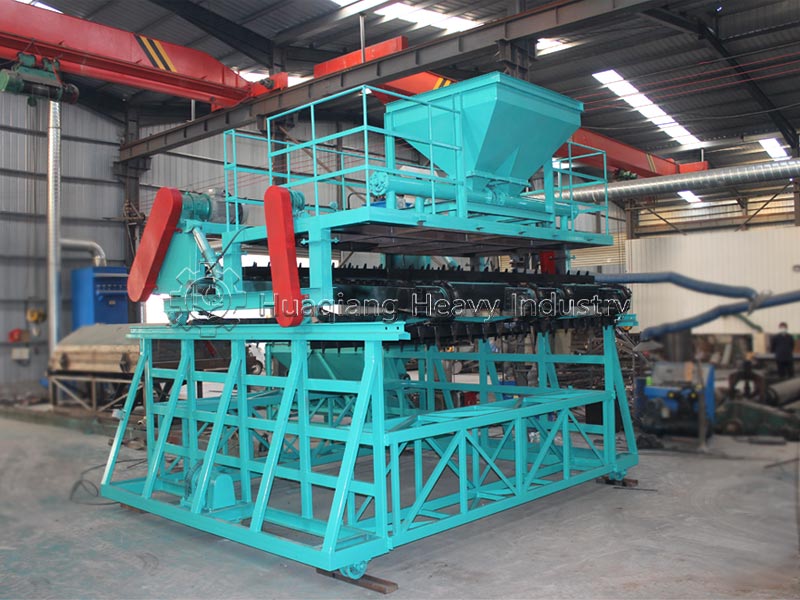

In organic fertilizer fermentation production lines, the hydraulic compost turning machine is the most versatile and widely used mainstream model, particularly suitable for large-scale, standardized organic fertilizer plants.
This equipment adopts a track-walking + hydraulic lifting structure, providing a large turning depth and uniform coverage. It can quickly break up material compaction, improve oxygen supply efficiency, and rapidly raise the fermentation temperature to 55-70℃, effectively killing pathogens, insect eggs, and weed seeds, and shortening the composting cycle. It operates stably with a low failure rate and is suitable for continuous fermentation of various raw materials such as chicken manure, pig manure, cow manure, and straw.
Secondly, the chain compost turning machine is suitable for materials with high moisture content and easy adhesion, such as kitchen waste, sludge, and highly moist manure. Its tracked structure prevents material from sinking or slipping, ensures thorough turning, is not prone to tangling, has strong adaptability to sticky materials, and produces high fermentation uniformity.
Double screws compost turners are primarily used in deep fermentation troughs. Their advantages include thorough material exchange between layers, resulting in more uniform fermentation. They are suitable for production lines with high composting requirements and medium output, effectively improving the quality of organic fertilizer.
Roller-type compost turners are suitable for large fermentation tanks and high-yield plants. They require less floor space, have a high degree of automation, and can be remotely controlled, saving labor and space.
In summary: large-scale standard organic fertilizer plants should prioritize hydraulic trough-type compost turners; chain-plate compost turners are preferred for high-moisture, viscous materials; double-helix compost turners are suitable for high composting levels; and large-scale, high-yield projects can utilize wheel-type compost turners.
When selecting a compost turner, consider the type of raw material, output, fermentation tank size, and automation requirements to find the most stable, efficient, and durable turner, ensuring smooth operation of the entire fermentation production line.