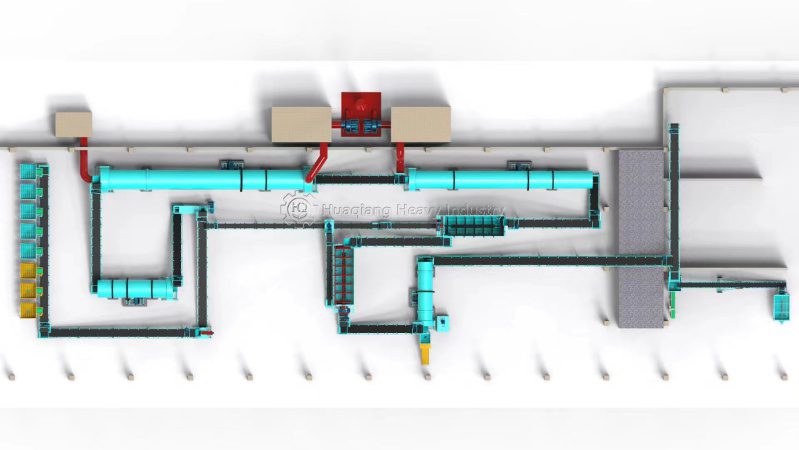

Reducing production costs of NPK blending fertilizer production lines requires meticulous management in four areas: raw material control, equipment operation and maintenance, production management, and energy and consumable consumption, while balancing efficiency and losses.
Prioritizing raw material management is the core of cost reduction. Centralize bulk procurement of raw materials to lower procurement and logistics unit prices; strictly inspect raw materials, controlling moisture content to ≤5% and particle uniformity to reduce agglomeration, segregation, and screening losses from the source. Plan the production sequence, concentrating similar formulas for continuous production to reduce material change frequency and minimize equipment waste and cleaning time. Classify and recycle screened agglomerates and waste materials, crush them, and reuse them to improve raw material utilization.
Strengthen the maintenance of NPK bulk blending machine to reduce failure losses. Develop a regular maintenance plan, calibrate batching scales on time, and inspect vulnerable parts such as conveyor belts and bearings to avoid capacity losses due to accuracy deviations and sudden shutdowns. Daily cleaning of residual materials in equipment prevents mixing and scrapping; timely maintenance of sealing and dust removal components prevents dust leakage. Optimize equipment operating parameters to match the capacity of each unit in batching, mixing, and packaging, avoiding idle or overload operation.
Optimize production and labor patterns. Increase the automation utilization rate of the production line, stabilize continuous full-load production, and reduce unit product energy consumption and fixed costs. Implement reasonable shift scheduling, streamlining redundant personnel by allowing one person to perform multiple roles, thus improving labor efficiency. Standardize work processes to reduce rework and waste caused by operational errors.
Strictly control auxiliary consumables and energy consumption. Select high-performance packaging bags and sealing accessories, and use them only as needed to avoid waste; optimize the use of auxiliary equipment such as dust removal and lighting, and shut them down promptly during non-operational periods. Plan the storage of raw materials and finished products rationally to improve space utilization and reduce warehousing and transportation costs. Multi-stage collaborative management can steadily reduce overall production costs.