

Driven by both precision agriculture and large-scale planting, the NPK Blending Fertilizer Production Line has become the preferred process route for compound fertilizer manufacturers to optimize product structure and reduce manufacturing costs. Unlike traditional chemical granulation methods, this production line uses physical blending as its core, directly mixing nitrogen, phosphorus, and potassium granular fertilizers and trace elements from different sources and with different particle sizes according to the formula to produce nutrient-balanced “BB fertilizer.” This process not only preserves the original form of each raw material, avoiding the energy consumption and pollution caused by chemical reactions, but also provides great flexibility in formula adjustment—the same production line can switch to producing customized fertilizers suitable for different crops and soils within minutes simply by changing the batching parameters. As a professional fertilizer equipment manufacturer, we understand that the value of this production line lies not only in its technological concept, but also in the ability of each piece of equipment to maintain stability, precision, and efficiency under continuous, high-intensity operating conditions. A complete NPK blending fertilizer production line consists of interconnected equipment. From upstream ingredient preparation to downstream packaging, the performance of each node directly impacts the quality and yield of the final product. The production line begins with the raw material storage system, typically equipped with multiple steel silos with volumes of 5 to 15 cubic meters, each corresponding to a specific basic raw material. The bottom of the silos is equipped with vibration-damping devices to ensure smooth flow of materials with varying flow rates. Following this is the core metering equipment—a high-precision electronic belt scale or loss-in-weight feeder—the very heart of the production line’s precision. Our system employs dynamic weighing and closed-loop feedback control technology, monitoring instantaneous flow rates in real time and comparing them with preset formulas to automatically adjust the feeding speed, ensuring that the ratio error of each raw material is stably controlled within ±0.2%. After metering, the material is conveyed to the mixing stage via a fully enclosed belt conveyor or bucket elevator. This stage utilizes a twin-shaft paddle-type NPK blending machine, whose unique “boiling point” mixing principle creates a triple mixing effect of convection, shearing, and diffusion under the action of high-speed rotating paddles. The uniformly mixed finished material is discharged through a pneumatic gate into a transition buffer bin, and then enters a fully automated quantitative packaging system.
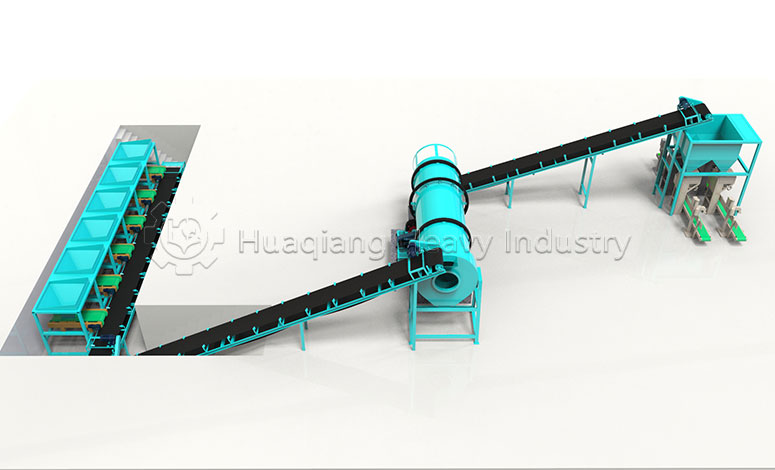
In addition to the standard configuration, our NPK Blending Fertilizer Production Line offers several value-added options to meet different customer needs. For example, for hygroscopic raw materials, we have added a hot air drying device and an air dehumidification system to prevent the material from absorbing moisture and clumping during conveying and mixing; for formulations containing large particles of urea or ammonium phosphate, we have designed an anti-breakage lifting device to reduce the particle breakage rate during material transfer; and for plants with strict environmental requirements, the entire production line is equipped with a pulse bag filter and a negative pressure dust collection hood to control the dust concentration below 10mg/m³, meeting national clean production standards.