

In fertilizer processing, there exists a variable that is rarely discussed yet omnipresent: the distance between granules. If the distance is too great, nutrient distribution becomes uneven, meaning the composition of every handful of fertilizer spread by a farmer varies; if the distance is too close, the granules stick together and clump, turning the entire bag into a rock-hard mass in the warehouse. The NPK blending fertilizer production line and the double roller press granulator represent two distinct process philosophies for managing this “inter-granular distance.”
The strategy of the NPK blending fertilizer production line is to “maintain distance.” Base fertilizers—such as urea, diammonium phosphate (DAP), and potassium chloride—emerge from upstream factories as high-quality granules that already possess natural spacing. The goal of this production line is not to bring the granules closer together, but to ensure they are “evenly dispersed.” It achieves this by precisely metering components according to a formula via a static weighing system and employing a low-speed convective mixing method. This allows granules of varying densities and sizes to repeatedly exchange positions within the mixing drum, ultimately achieving a statistically uniform distribution without compromising the structural integrity of the original granules. The underlying logic is simple: since each raw material is already a high-quality granule, there is no need for “intimate contact”; maintaining an appropriate distance and ensuring uniform coexistence represents the optimal state for blended fertilizers.
The double roller press granulator, conversely, moves toward the opposite extreme—it seeks to “eliminate distance.” When raw materials are powders rather than granules, the gaps between particles are too wide for intermolecular forces to bridge, leaving the powder in its loose, unbonded state. The solution offered by the double roller press granulator involves using two counter-rotating, high-strength rollers to instantly compress the powder into a thin sheet under pressures reaching hundreds of megapascals. In that instant, the powder particles are forced close enough for intermolecular forces to “join hands”—Van der Waals forces, adsorption, and crystal bridge connections come into play, transforming the loose powder into a dense, solid sheet. The entire process requires neither added water nor increased temperature, relying solely on the physical principle of “compressing the distance until it is sufficiently small.”
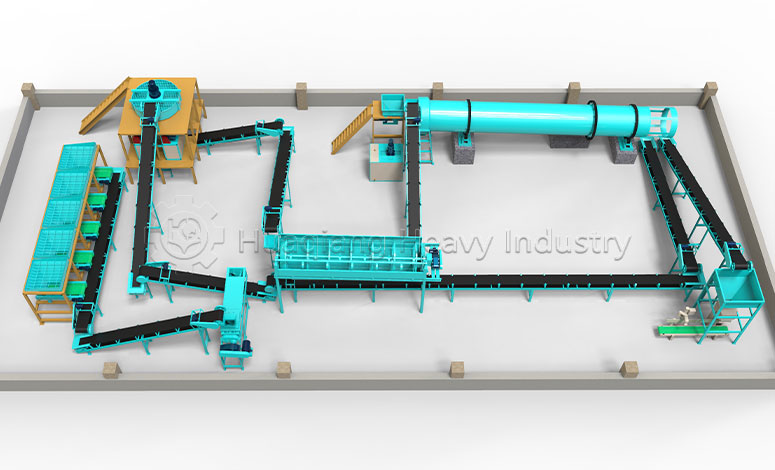
The roller press granulation production line addresses a challenge in a different dimension: how to transform this “compression of distance” from a standalone mechanical action into a continuous production flow. In a complete extrusion granulation line—spanning raw material feeding, roller extrusion, flake crushing, granule screening, and final packaging—every stage must maintain a synchronized rhythm. Material cannot be allowed to accumulate, as buildup implies that some particles miss the optimal moment for extrusion; conversely, the flow cannot be interrupted, as idling rollers suffer unnecessary wear. The true value of the production line lies in converting “instantaneous distance compression” into a repeatable, controllable, and scalable continuous process, reliably transforming tons of powder per hour into granules of consistent strength.