

The service life and output quality of fertilizer equipment often depend not on the equipment’s nominal specifications, but on several easily overlooked operational details. From NPK blending machines to double-roller press granulators, deviations at any stage are amplified in the final product.
For NPK blending machines, precision is more critical than production capacity. Many buyers prioritize hourly tonnage when selecting equipment, yet the key to successful BB (Bulk Blending) fertilizer production lies in batching accuracy. An NPK blending machine with a capacity of 20 tons per hour but a batching error of ±1% actually produces 20 tons of “approximate” fertilizer; the nutrient deviation is often sufficient to push the entire batch outside the limits allowed by national standards. Conversely, a machine with a capacity of 15 tons per hour but ±0.2% precision consistently meets standards, making it more cost-effective in the long run. Precision should not be judged solely by specification sheets; buyers should require manufacturers to conduct continuous batching tests using actual raw materials and record weighing deviations for each batch. Another often overlooked detail is the residual material rate—material remaining on the inner walls and mixing paddles of the NPK bulk blending machine can directly contaminate the next batch when the formula is changed.
Decisions regarding the replacement of roller shells on double-roller press granulators should be based on data. One should not wait until granule strength drops significantly to address roller shell wear. The depth of the pattern on the roller surface is a more sensitive indicator: new roller shells typically have a pattern depth of 23mm; when wear reduces this to two-thirds of the original depth, the roller’s ability to “bite” and grip the material diminishes noticeably. At this stage, the extruded material sheets begin to show loose edges and uneven thickness, causing the granulation rate to plummet from 80% to below 60% in a short period, while the volume of recycled material surges. Another important indicator is the roller surface temperature. During normal operation, the temperature usually ranges between 50°C and 65°C; if it consistently exceeds 70°C, it indicates excessive friction in the compression zone, potentially caused by low material moisture content or roller wear that has compromised the gripping capability. The criteria for replacing the roller shells on a fertilizer roller press are clearly defined: replacement is required if the tread pattern wears down by more than two-thirds of its original depth, the effective shell thickness decreases by one-third, or if cracking or spalling occurs.
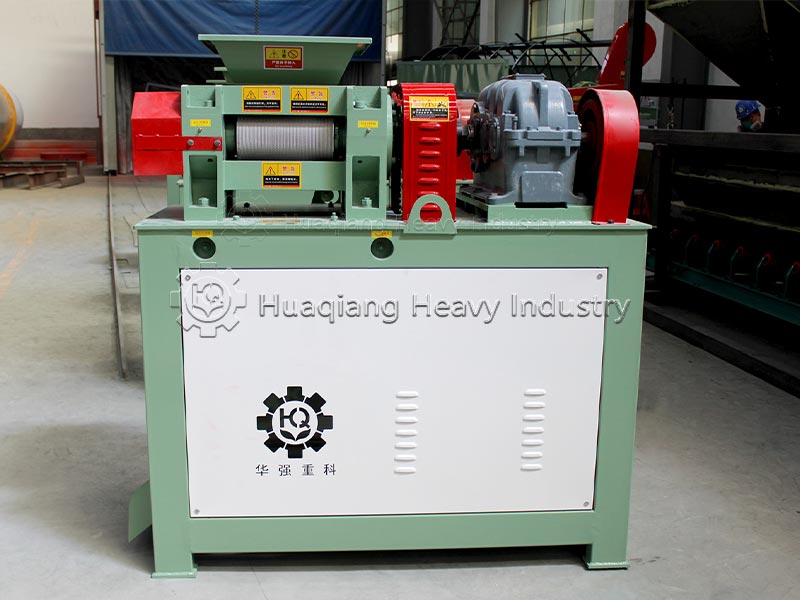
Material moisture content is the variable most frequently overlooked in roller press granulation lines. The ideal moisture content for double roll extrusion granulation typically ranges from 8% to 15%. If the moisture content is too high, material stickiness increases sharply, causing the material to adhere to the roller surface and form a film—a phenomenon known as “roller fouling.” Conversely, if the moisture content is too low, fine powder tends to accumulate and cake on the roller surface. In actual production, it is recommended to install an online moisture analyzer between the mixing and extrusion stages to maintain the input moisture within the target range in real-time. If the raw material’s natural moisture content is high, dry recycled material or inert fillers can be added during the mixing phase to dilute the moisture; if it is low, water should be sprayed into the mixer and thoroughly blended.
Stable production line operation also depends on a frequently overlooked design element: the buffer hopper. Twin-roll extrusion granulation is a continuous process that is highly sensitive to the consistency of the material feed. If powdered material is discharged in batches from the mixer into the extruder hopper, the material level fluctuates drastically: an excess of material overloads the extrusion zone and causes current spikes, while a shortage leads to the rollers idling and accelerates wear. By installing a buffer hopper upstream of the extruder—equipped with a variable-frequency screw feeder and a level sensor to maintain the material level between 60% and 80%—the extruder can operate under a constant load, resulting in more stable granule density and strength.