

In fertilizer production, the definition of “precision” varies significantly across different stages. For BB fertilizer production lines, precision refers to weight accuracy; a multi-silo, single-scale static batching system weighs each raw material individually in a static state, keeping the error margin within ±0.2%. In contrast, precision for organic fertilizer fermentation lines refers to spatial accuracy; the core performance indicators for hydraulic, windrow, and large-wheel compost turners are turning depth and uniformity. Conflating these two concepts leads to incorrect equipment selection.
For BB fertilizer production lines, precision means “accurate weighing.” A complete BB fertilizer production line consists of raw material silos, a metering system, mixing equipment, and a packaging machine arranged in sequence. The multi-silo, single-scale static batching system is the starting point for this accuracy: raw materials are discharged sequentially into a single weigh hopper, weighed statically one by one, and then conveyed collectively, ensuring the process remains unaffected by fluctuations in conveyor belt speed. Accurate batching allows the BB fertilizer mixer to deliver optimal performance: the twin-shaft paddle structure achieves mixing within 2 to 5 minutes, maintaining a coefficient of variation (CV) for uniformity of ≤5% and keeping granule breakage below 0.5%. The core of the mixing process is “shape-preserving mixing”—achieving thorough blending without damaging the original form of the granules. Excessive mixing time or rotation speed accelerates granule pulverization, causing fine powder to settle at the bottom after packaging and resulting in uneven nutrient distribution.
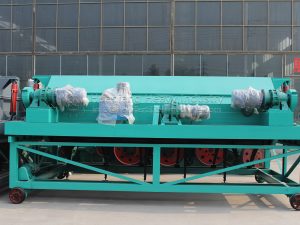
For fermentation lines, precision means “thorough turning.” An organic fertilizer fermentation pile is a dynamic system, and the choice of turning equipment depends on the specific fermentation scenario. Hydraulic compost turners feature hydraulic drive systems, offer deep turning capabilities and robust overload protection, and are well-suited for channel-based aerobic fermentation; windrow compost turners utilize crawler tracks for excellent terrain adaptability, making them ideal for windrow fermentation and a more cost-effective investment; large-wheel compost turners employ large-diameter turning wheels, enabling a single unit to process hundreds of tons daily—perfect for large-scale production; the term “fermentation compost turner” serves as a general category encompassing all the aforementioned types. Insufficient turning depth leads to prolonged oxygen deprivation at the pile core, extending fermentation cycles from 15 to 60 days and causing significant nitrogen loss; conversely, excessive turning results in rapid heat loss, which also hinders proper decomposition.
These two types of precision are neither interchangeable nor substitutable. Selecting a compost turner with the mindset of a batching system leads to a focus solely on “throughput (tons per hour)” while overlooking turning depth and uniformity; conversely, selecting a batching system with the mindset of a compost turner leads to a focus solely on “continuous feeding capability” while ignoring the value of static weighing precision. Bulk Blend (BB) fertilizer lines require “dry mixing and precise proportioning,” whereas fermentation lines require “wet turning and adequate aeration.” Equipment from these two lines cannot be used interchangeably: a BB fertilizer mixer will experience shaft clogging when processing wet materials, while a compost turner will crush the finished product when processing granular materials.