

When selecting a fertilizer production line, there is an easily overlooked engineering fact: although they process the same NPK raw materials, the blending process and the extrusion granulation process address two completely different physical challenges. NPK blending lines deal with pre-formed granules; their task is to achieve precise formulation without altering the physical form of the raw materials. In contrast, double-roller press granulators handle loose powders; their task is to impart a new physical density to the material through the application of pressure. Understanding this fundamental difference is more practically significant than simply comparing the specifications of individual machines.
The core challenge of the blending process lies not in the mixing itself, but in preventing segregation. The bulk density of urea granules is approximately 1.33 g/cm³, while that of potassium chloride is as high as 1.98 g/cm³—a difference of nearly 50%. During mixing and transport, this density disparity drives spontaneous particle stratification, causing lighter granules to rise and heavier ones to sink. Consequently, the design logic of NPK bulk blending machines centers on “particle size matching” and “gentle mixing.” The proportioning stage utilizes multi-bin static weighing where each raw material is weighed individually, achieving a metering accuracy of ±0.2%, while the mixing stage employs low-speed convection to avoid damaging the original shape of the granules. However, the quality of blended fertilizer is often determined by screening control prior to the materials entering the plant; keeping the difference in average particle size between components within 1 mm is far more effective than simply extending the mixing time.
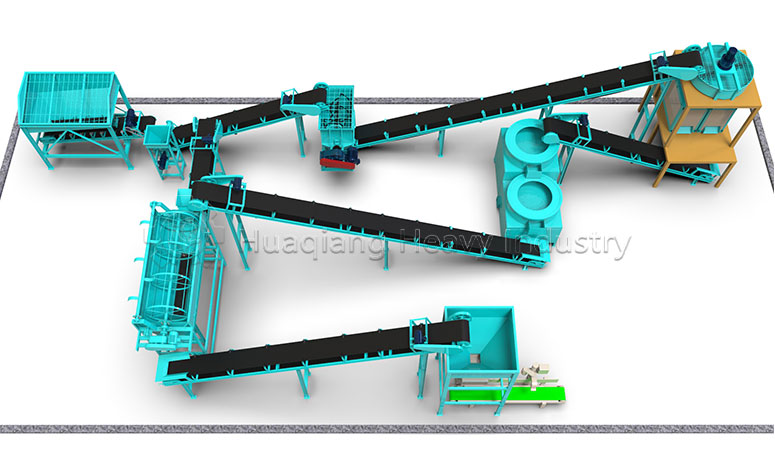
Extrusion granulation follows a completely different technical path. The core principle of the fertilizer roller press machine involves two counter-rotating, high-strength rollers that compress dry powder into a dense sheet at ambient temperature; this sheet is subsequently crushed and screened to produce granules. The entire process requires neither water nor heat, and the moisture content of the raw materials must be kept below 5%. This dry-process route eliminates the drying and cooling systems required for wet granulation; through optimized process control, the entire roller press granulation line can achieve energy savings of over 30%. Granule density increases by 1.5 to 3 times, and compressive strength reaches 20–50 N per granule, resulting in negligible dusting during loading, transport, and multi-layer stacking. However, there are clear trade-offs: roller surfaces wear out relatively quickly, requiring periodic replacement of roller shells, and the resulting granules are irregular in shape, necessitating a secondary shaping step for applications requiring high aesthetic quality.
The choice between these two routes boils down to a specific engineering assessment: blending lines are ideal for scenarios where raw materials are already qualified granules and formulations require frequent switching—offering low investment, low energy consumption, and quick implementation. Extrusion lines are suited for formulations using powdered raw materials or ingredients prone to deliquescence upon contact with moisture (such as urea), as the dry process inherently avoids the complications caused by water. The core technical challenge of double-roller press granulation lies not in the extrusion action itself, but in the prerequisite of consistently feeding homogenized powder into the gap between the rollers. The first step in selection is not comparing price quotes, but verifying the initial state of the raw materials—as this determines which process route is physically feasible.