

When selecting organic fertilizer granulation equipment, there is a fundamental dividing line—even more critical than specific power consumption or production capacity—which is the moisture content of the feedstock. For composted livestock and poultry manure, if the moisture content falls between 25% and 35%, disc granulation is a mature and economical choice. Conversely, if the moisture content drops below 5%, dry extrusion becomes virtually the only viable processing route. This is not a debate over which equipment is “better,” but rather a rigid constraint imposed by the state of the raw material on the chosen process.
Disc granulation follows a “wet agglomeration” approach. In a tilted, rotating disc, materials tumble repeatedly under the combined influence of friction, centrifugal force, and gravity. Atomized water moistens the fine particles layer by layer, causing them to accumulate around a “nucleus” and grow into larger granules, which eventually spill over the edge of the disc. This process is most effective when the organic material has a moisture content of 25% to 35%, yielding a granulation rate of over 93%. Its advantages include a simple structure and a lower initial investment; the resulting granules are roughly spherical, meeting the market requirements for standard organic fertilizers. However, the process offers limited control over particle size uniformity, has a relatively lower production capacity, and produces granules with high moisture content, necessitating additional drying and cooling systems for safe storage.
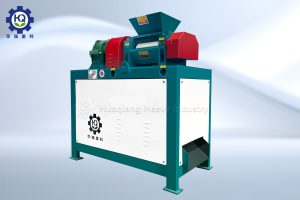
Dry extrusion, by contrast, sits on the other side of the moisture content divide. Centered around a double-roller press granulator, this technology utilizes two high-strength, counter-rotating rollers to compress powdered material into dense “cakes” at ambient temperature. The bonding between particles is achieved through intermolecular forces—such as van der Waals forces, adsorption, and crystalline bridges—without the addition of any water or any increase in temperature. The feedstock requirements for this method barely overlap with those of disc granulation: the moisture content must be kept below 5%, and the particle size of the input material must not exceed 0.6 mm. If the moisture content exceeds the specified limit, the damp material will slip between the rollers, resulting in an uneven thickness of the compacted sheets. Similarly, if the particle size is too coarse, the material’s “bite” into the rollers becomes unstable, leading to a decline in the consistency of granule strength.
A complete roller press granulation production line typically comprises a metering feeder, a forced-feeding system, the main roller press unit, a crusher, a multi-stage screening system, and a packaging machine. The screening stage creates a closed loop by returning oversized particles to the crusher while directing qualified granules to the finished-product silo. The core challenge of roller press granulation technology lies not in the compaction process itself, but in ensuring the stable, uniform feeding of powdered material into the gap between the rollers—a process that requires both the moisture content and particle size of the feedstock to remain within a strictly defined, optimal range. The primary engineering advantage of this approach is the elimination of a dedicated drying stage; it reduces total energy consumption by 30% to 50% compared to wet-granulation processes, while increasing granule density by 1.5 to 3 times—resulting in granules that are highly resistant to pulverization during transport or multi-layer stacking.
It is also worth noting the “gap” between these two processing routes: when raw material moisture content fluctuates between 25% and 45%, and precise pre-drying of each batch is not feasible, the material may fall outside the operational window for both disc granulation and dry-powder roller compaction. Regardless of the chosen path, the initial assessment remains the same: determining the moisture content of the raw material as it emerges from the fermentation tank or drying line. The first step in selecting the right equipment is to ensure the moisture content aligns with the chosen process, rather than attempting to adapt the process to the raw material.