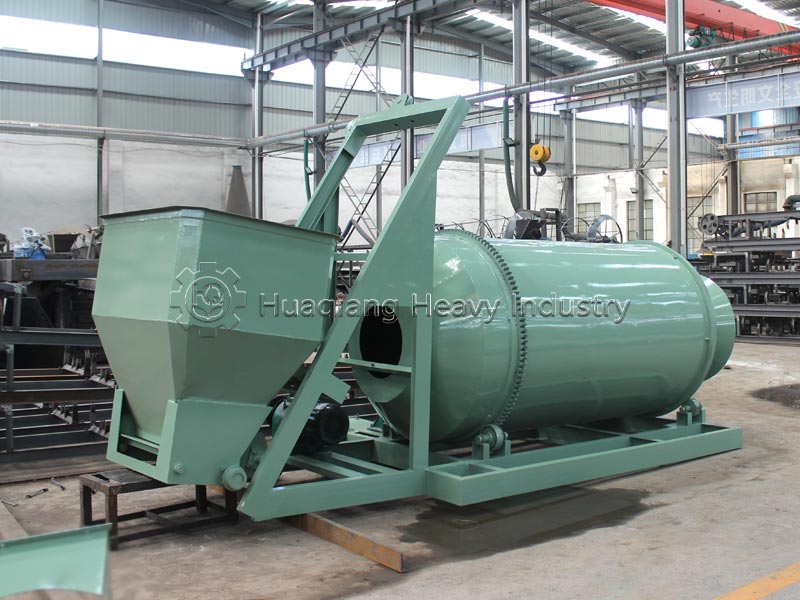

The BB fertilizer mixer production process focuses on precise ingredient proportioning, uniform mixing, dust-free operation, and preventing breakage. The process is simple and highly automated, suitable for blending nitrogen, phosphorus, potassium, micronutrients, and organic fertilizer granules.
The first step is raw material preparation and screening. Basic fertilizers with similar particle size, meeting strength standards, and non-hygroscopic properties, such as urea, diammonium phosphate, potassium chloride, and ammonium sulfate, are selected. Pre-screening removes broken powder, lumps, and impurities to prevent uneven particle size, stratification, or blockage. Raw materials must be kept dry; excessive moisture content should be avoided to prevent clumping and sticking to the walls.
The second step is automatic ingredient proportioning. Electronic batching scales accurately measure according to the formula ratio, simultaneously and quantitatively conveying multiple raw materials to ensure stable proportions and minimal error. The batching system can automatically adjust to meet different formula requirements; the accuracy of batching directly affects the finished fertilizer’s effectiveness.
The third step is closed-loop mixing. The raw materials enter the BB fertilizer mixer, where they are rapidly and evenly mixed under the action of a spiral or paddle. The mixing time is generally 3-5 minutes, aiming for no obvious color difference and uniform particle distribution. The mixing process should be kept at a low speed and gently to prevent particle breakage and powder generation, while maintaining a closed system to reduce dust.
The fourth step is screening and finished product conveying. After uniform mixing, the mixture enters the finished product screen to remove debris and lumps, ensuring intact particles and good appearance. Qualified material on the screen enters the packaging hopper, while material undersized can be returned to the machine for re-mixing.
The fifth step is automatic metering and packaging. A quantitative packaging machine is used for bagging and sewing, ensuring accurate metering and secure sealing to prevent moisture absorption and clumping.
During production, the following points should be noted: the raw material moisture content should be low to prevent clumping; the mixing speed should not be too fast; the equipment should be sealed and dust-free; residues should be cleaned every shift to prevent cross-contamination; and formula records and quality spot checks should be maintained to ensure the mixing uniformity meets standards. The entire process is continuous and stable, easy to operate, and suitable for large-scale BB fertilizer production.