

The fertilizer processing industry faces a classic choice: are the raw materials granules or powders? The answer dictates which production line to choose. The BB fertilizer production line and the roller press granulator production line represent the optimal solutions for these two distinct material states, with the BB fertilizer mixer serving as an indispensable component of the former.
Let’s first look at the logic of “blending.” The core philosophy of the BB fertilizer production line is simplicity—avoiding unnecessary processing. Base fertilizers like urea, diammonium phosphate (DAP), and potassium chloride emerge from chemical plants as finished granules with intact structures and clearly defined nutrient content. The BB fertilizer line simply weighs, mixes, and packages these finished granules from various sources according to customer-specified formulas, without altering the chemical composition or physical form of the raw materials. Success here hinges on precision and gentleness. Precision is achieved through a multi-bin static batching system where each raw material is weighed individually, keeping margins of error minimal. Gentleness is ensured by the BB fertilizer mixer; this machine utilizes a horizontal twin-shaft paddle structure that employs low-speed convective mixing. This allows granules of varying densities and sizes to thoroughly intermingle within the mixing chamber without undergoing violent collisions. Consider that the bulk density of urea is approximately 0.75 g/cm³, while that of monoammonium phosphate (MAP) is about 0.95 g/cm³; if mixing is too aggressive, lighter granules float while heavier ones sink, resulting in uneven nutrient distribution in the final product. A well-designed BB fertilizer mixer can achieve a coefficient of variation for mixing uniformity of less than 5% within one to three minutes, while keeping the granule breakage rate below 0.5%—meaning that after mixing and discharge, every granule retains its original form.
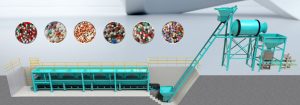
Next, consider the logic of “pressing.” The roller press granulator production line addresses a different scenario: one where the raw materials are powders or exist in a physical form unsuitable for direct application. The twin-roll extrusion granulation production line employs a dry, high-pressure forming process: two counter-rotating, high-strength rollers instantly compress powdered material into a thin sheet, which is subsequently crushed and screened to yield the final granules. The entire process requires neither water nor heat input, resulting in a material moisture content that is virtually negligible. In the fertilizer industry, extrusion granulation was first applied to potassium chloride; indeed, the granular potassium chloride required for bulk-blended (BB) fertilizers is predominantly produced via this extrusion method. This production line consumes 30% to 50% less energy than wet granulation processes, as it eliminates the need for massive drying and cooling systems. More importantly, it handles materials that are difficult to process using wet methods—such as high-urea formulations that would deliquesce and clump upon contact with water, or composted livestock manure, which has high fiber content and poor cohesiveness, making it hard to form into pellets on a granulation disc. In contrast, twin-roll extrusion accommodates these “difficult” raw materials with ease, producing granules with high density and strength that resist crumbling during storage, transport, and mechanical spreading.