

In the field of fertilizer production, double roller press granulators and NPK blenders represent two distinct process routes. The former directly converts powdered raw materials into granules under high pressure, while the latter precisely blends pre-formed granules according to a formula. Each path has its applicable scenarios, and there is no absolute superiority or inferiority; the key lies in matching the raw material conditions and market demands.
double roller press granulators (also known as fertilizer roller press granulators) follow the dry press technology route. The process principle of this equipment is to directly compress dry powder materials into dense flakes or strips through the relative press of two rollers. Specifically, the material agglomerates into dense, hard lumps under high pressure; this process is called press. The core functions of press are twofold: first, to expel air between particles; and second, to shorten the distance between particles to a sufficiently close level, thereby generating intermolecular forces such as van der Waals forces, adsorption forces, crystal bridges, and intercalation. The strength of particles formed by press granulation is mainly maintained by the intermolecular forces. After the material cake leaves the pressure rollers, it undergoes crushing and screening to obtain finished particles that meet the particle size requirements. A key advantage of the double-roller press granulator is that it requires no water or heating throughout the entire process, making it a typical room-temperature dry process. The entire granulation process eliminates the drying and cooling steps necessary for wet granulation, significantly reducing energy consumption per ton of fertilizer and producing no waste. The granulation rate of this equipment can reach over 95%, producing particles with high density and strong compressive strength, making them less prone to pulverization during storage and transportation. A double-roller press granulation production line typically consists of a batching system, a double-roller press granulator, a crusher, a screening machine, a coating machine, and belt conveyors. The entire production line has a compact layout, moderate investment, and rapid commissioning, making it suitable for large-scale granulation production of dry powders with a moisture content of less than 5%.
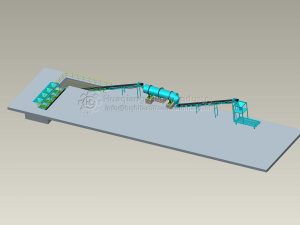
Unlike the “powder-to-granule” process of press granulation, the NPK blender and BB fertilizer blending production line perform a purely physical mixing task of “granule-to-granule”. The raw materials for BB fertilizer (blended fertilizer) are already granulated single-element fertilizers—such as large-particle urea, monoammonium phosphate, and potassium sulfate. The essence of the production process is to directly blend particles of different forms according to soil testing and formulation data, without involving any chemical reactions. A standard BB fertilizer blending production line consists of four main modules: a raw material storage and conveying system, a dynamic batching and metering system, an NPK blender, and an automatic packaging system. During production, the base fertilizer is fed into its respective buffer silo via a bucket elevator. The silo bottom variable frequency screw feeder dynamically accumulates and measures the material according to the set formula, with a measurement error controllable within ±0.2%. The metered material then enters the NPK blender, which uses a three-dimensional convection tumbling mixing principle to achieve all-round, dead-angle-free mixing of the material. The mixing process is gentle yet efficient—slow-rotating blades or spirals gently agitate the particles, achieving uniform distribution without disrupting their original morphology. Mixing time is typically controlled within 3 to 5 minutes, and the coefficient of variation for mixing uniformity can be kept below 5%. The entire production line is centrally controlled by a PLC, allowing for flexible and convenient formula switching—the same production line can produce dozens of different formulas on the same day.
In the production of bio-organic fertilizers, the bio-organic fertilizer disc granulator offers another granulation option. This equipment uses a disc-type rotary granulation structure, where materials tumble and grow within the tilting, rotating disc under the combined effects of centrifugal force, friction, and gravity, forming spherical particles. Its key advantage is room-temperature operation—the entire pelletizing process requires no heating, and the functional microorganisms added during granulation are not deactivated by high temperatures. The disc is lined with high-strength fiberglass, providing corrosion resistance and wear resistance.
The double roller press granulation production line and the BB fertilizer blending production line—one is responsible for “granulation,” and the other for “granulation.” The former, characterized by dry molding and the elimination of the need for drying, is suitable for large-scale production starting with powdered raw materials; the latter, known for its flexible formulations, low investment, and quick returns, is suitable for precise formulation using finished granules as raw materials. Each approach has its advantages; choosing the one that best suits your needs is the best answer.