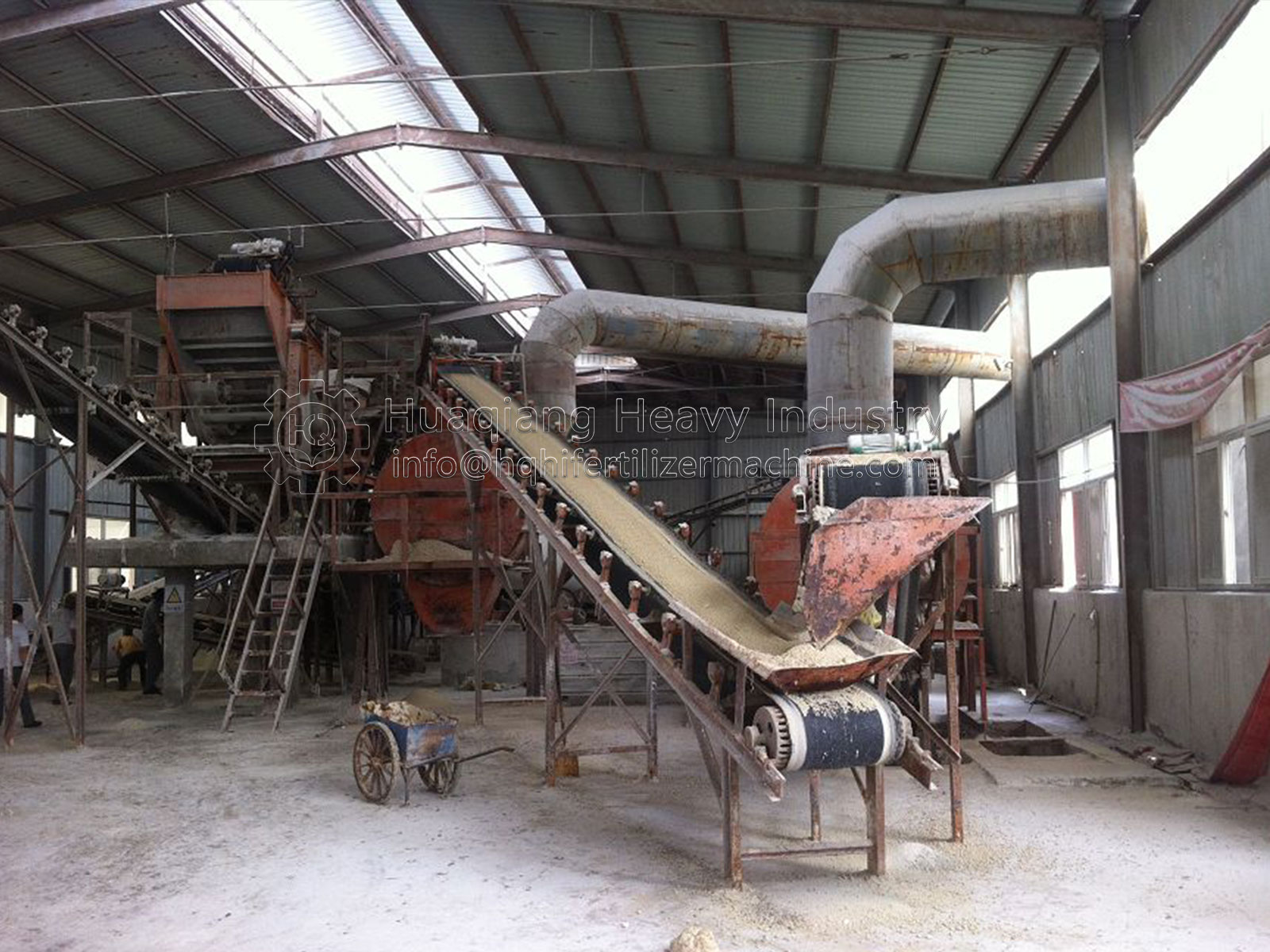

The NPK blending fertilizer production line project is divided into seven stages: project approval, site planning, equipment selection and procurement, process layout, installation and commissioning, compliance during production, and post-construction operation. Blended fertilizer production involves only physical mixing, without drying or granulation, resulting in a short project cycle and rapid implementation.
The first stage involves obtaining necessary permits and licenses, including business registration, environmental impact assessment filing, and land use registration. Following this, a fertilizer production license will be applied for. Finished products will be submitted for testing to obtain nutrient analysis reports. Simultaneously, market connections will be established, and the main formula (15-15-15, high-nitrogen topdressing, fruit and vegetable fertilizer, etc.) will be finalized. Annual production capacity of 30,000/50,000/100,000 tons will be determined, and hourly production capacity will be calculated based on this.
The second plant’s civil engineering plan requires a total area of 300-600 square meters for small-scale production lines, including raw material storage, production workshop, and finished product storage. The plant’s ceiling height should be ≥5.5 meters for convenient vertical silo loading. Raw materials should be stored separately for urea, monoammonium phosphate, diammonium phosphate, potassium chloride, and trace elements, with moisture and rain protection. Space should be reserved in the workshop for dust removal and power distribution. The production line will adopt a linear layout: raw material storage → batching → mixing → packaging → finished product storage, shortening the conveying distance and reducing particle segregation.
The third plant requires customized NPK blending machine. Depending on the raw material type, the equipment will include a 5-8 bin automatic batching scale (metering accuracy ±0.2%), a twin-shaft high-efficiency mixer (mixing uniformity ≥95%), a fully automatic quantitative packaging machine, belt conveyor, pulse dust collector, and PLC electrical control system. Small and medium-sized plants can opt for semi-automatic pit feeding, while large plants will use vertical steel plate storage silos for fully automated feeding.
Fourth, installation, commissioning, and trial production: Installation should be completed within 10-20 days after equipment arrival. First, a no-load test run should be conducted, followed by small-batch trial mixing with urea and phosphate/potassium raw materials to optimize batching parameters and mixing time (60-180 seconds). Issues such as material stratification, metering errors, and dust generation should be addressed. After three consecutive days of trial production, once the nutrient content of the finished product meets standards, final commissioning should be completed.
Fifth, production commissioning and operation preparation: Sufficient testing equipment should be provided, and a system for sampling and inspecting raw materials upon warehousing and retaining finished product samples should be established. Batching, central control, and packaging operators should be trained. Long-term suppliers of urea and potash fertilizer should be secured. Production should be flexibly scheduled according to orders, and future warehouse expansion space should be reserved to facilitate the addition of micronutrients and humic acid blends.