

There is an engineering rule in the fertilizer processing industry that has been repeatedly validated yet often overlooked: the success or failure of equipment selection is often determined the moment raw materials enter the plant. Take a batch of NPK raw materials, for instance: if they arrive as finished granules, the NPK Blending Fertilizer Production Line is the pragmatic choice; if they are loose powders, they must be routed to the dry extrusion process centered on the double-roller press granulator; and if they are fermented, decomposed organic materials, the bio-disk organic fertilizer machine is the right fit. Each of the three routes comes with a specific “raw material promise”; choose the wrong one, and every subsequent processing step will be fraught with difficulties.
The promise made by the blending line to its raw materials is: “You must be finished granules.” Urea, diammonium phosphate (DAP), and potassium chloride arrive from upstream plants as fully formed granules; the blending line’s task is simply to weigh and mix them accurately. The batching stage employs multi-bin static weighing, where each raw material is weighed individually, keeping metering precision within ±0.2%. However, this route has a strict requirement: the difference in average particle size between the various components should ideally be kept within 1 millimeter. Urea has a bulk density of approximately 0.75 g/cm³, while potassium chloride is close to 1.98 g/cm³—a nearly threefold difference. If particle sizes also vary significantly, vibrations during transport can cause the granules to segregate, meaning the actual nutrient content in the bags reaching farmers may deviate sharply from the formula specifications. The key to solving this problem lies not in the mixer itself, but in the screening process before the raw materials enter the plant.
The promise made by the extrusion line to its raw materials is: “You must be dry powder.” The double-roller press granulator employs two counter-rotating, high-strength rollers to instantly compress powdered material—with a moisture content of no more than 5%—into dense sheets at ambient temperature; these sheets are subsequently crushed and screened to produce granules. The entire process requires neither added water nor heat, eliminating the need for the drying and cooling systems essential to wet granulation and reducing overall energy consumption by 30% to 50% compared to wet processes. However, this method imposes strict limits on input moisture content; if levels exceed the 5%–8% range, the material slips between the rollers, resulting in uneven sheet thickness. For “sensitive” formulations that deliquesce upon contact with water or melt when exposed to heat, dry extrusion is often the only viable forming method. The trade-off is that the patterned roller surfaces are wear parts requiring regular inspection and replacement.
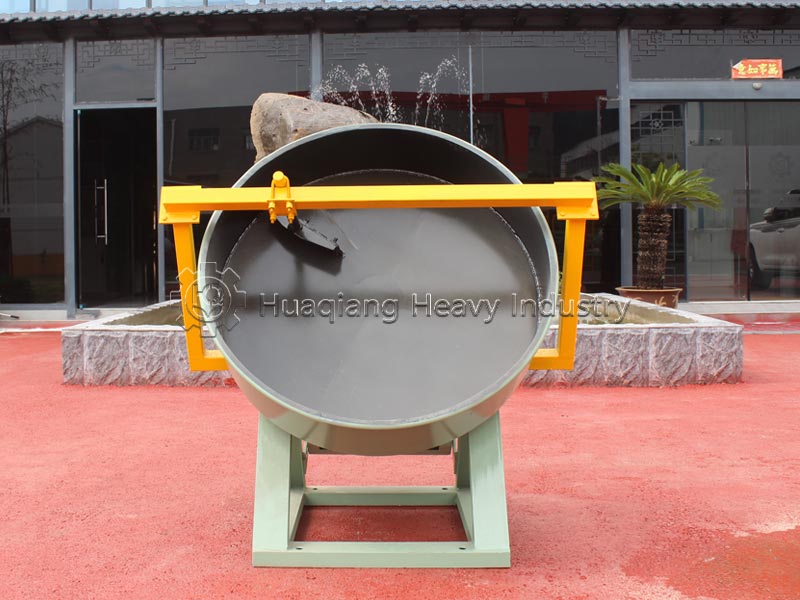
The disc granulator requires raw materials to be well-decomposed and possess moderate moisture content. It processes fermented organic materials—such as livestock manure, crop stalks, and spent mushroom substrate—which typically have moisture levels between 25% and 35%, high viscosity, and strong fibrous characteristics. The disc’s inclination angle is adjustable between 35° and 55°; materials tumble and agglomerate under the combined forces of gravity, centrifugal force, and friction, achieving a pelletization rate exceeding 90%. Granules produced via this method are highly spherical with smooth surfaces, but the process necessitates drying and cooling equipment, with coal costs for drying ranging from 50 to 70 yuan per ton of finished product. It is unsuitable for dry powders or fresh manure with excessive moisture; the raw material must undergo a preliminary fermentation and decomposition stage.
The specific raw material requirements of these three methods constitute the first decision point in equipment selection: where your raw material originates, its physical form, and its moisture content range. Blending lines are suitable for fertilizer blending stations where raw materials are already qualified granules and formulations require frequent changes; extrusion lines are suited for large-scale production involving powdery raw materials or ingredients—such as urea—that are prone to deliquescence upon contact with moisture; and disc granulation lines are ideal for scenarios involving the resource utilization of organic waste or where a premium granule appearance is desired for commercial appeal. The first step in equipment selection is never comparing price quotes, but rather verifying whether the initial state of the raw materials falls within the “operational window” of the chosen process.