

The most troublesome problem in BB fertilizer production isn’t equipment failure, but rather that even with normal equipment operation, identical formulas, and unchanged operating procedures, the nutrient content of the produced fertilizer fluctuates wildly. The problem isn’t with the formula, but with every detail of an NPK blended fertilizer production line, from batching to packaging—you might think the equipment is “repeating” the same action, but in reality, each run is interfered with by different factors.
Ingredient accuracy drift is the first hidden killer. Electronic belt scales can achieve ±0.2% accuracy on the day of calibration, but after a week of operation, factors such as sensor zero-point drift, belt adhesion, and material bridging can combine to widen the actual batching error to over ±1%. On a production line with an annual output of 50,000 tons, a 1% deviation means that the nutrient content of 500 tons of product deviates from the target value each year. The key to solving the problem lies not in buying more expensive scales, but in establishing a daily calibration system—calibrating the scales with standard weights before each shift and regularly cleaning any accumulated material from the scales.
Particle segregation is the second hidden killer. Even with precise ingredient proportions and thorough mixing, problems can still arise later. Urea (bulk density approximately 1.33 g/cm³) and potassium chloride (approximately 1.98 g/cm³) have a density difference of nearly 50%. During the conveying and packaging process after mixing, heavier particles sink to the bottom while lighter particles float. The nitrogen, phosphorus, and potassium content in different packaging bags of the same batch of fertilizer can vary drastically. Production lines address segregation by requiring all raw material particles to have similar sizes (difference controlled within ±0.5 mm), and using belt conveyors instead of chutes to reduce free fall height. Some production lines also install anti-segregation baffles or conical mixing devices in the silos.
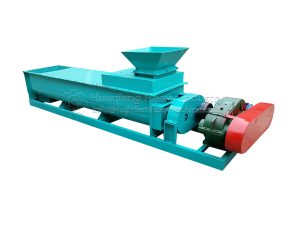
The “standardization” trap of mixing time is the third hidden killer. Many operating manuals specify a mixing time of 5 minutes, which operators strictly adhere to. However, the mixing difficulty varies depending on the formulation. High-nitrogen formulations (28-6-6) have a high urea ratio and brittle particles; excessive mixing time can lead to pulverization of the particle surface. High-phosphorus formulations (12-24-12) require even longer mixing times to achieve the required uniformity. The core advantage of a twin-shaft paddle mixer lies in its wide mixing time window, but this requires operators to adjust the time according to the formulation, rather than rigidly adhering to a single number. Currently, some high-end production lines employ continuous mixing processes, where multiple raw materials are fed simultaneously and mixed while flowing within the mixer, achieving uninterrupted production.
Problems with the entire production line cannot be solved by a single step. An NPK blended fertilizer production line consists of a raw material silo, metering system, mixing equipment, and packaging machine connected in series. Issues with batching accuracy require checking the scale calibration; segregation issues need to be addressed by examining the raw material particle size and conveyor design; and mixing uniformity issues depend on blade wear and mixing time. For nutrient fluctuations in the same formulation, the troubleshooting order should be: scale → raw material particle size → mixing time → conveyor drop. This is also the core logic of the entire production line—it’s not about which piece of equipment is the most expensive or the most important, but rather that every link determines whether the final product can pass the test.