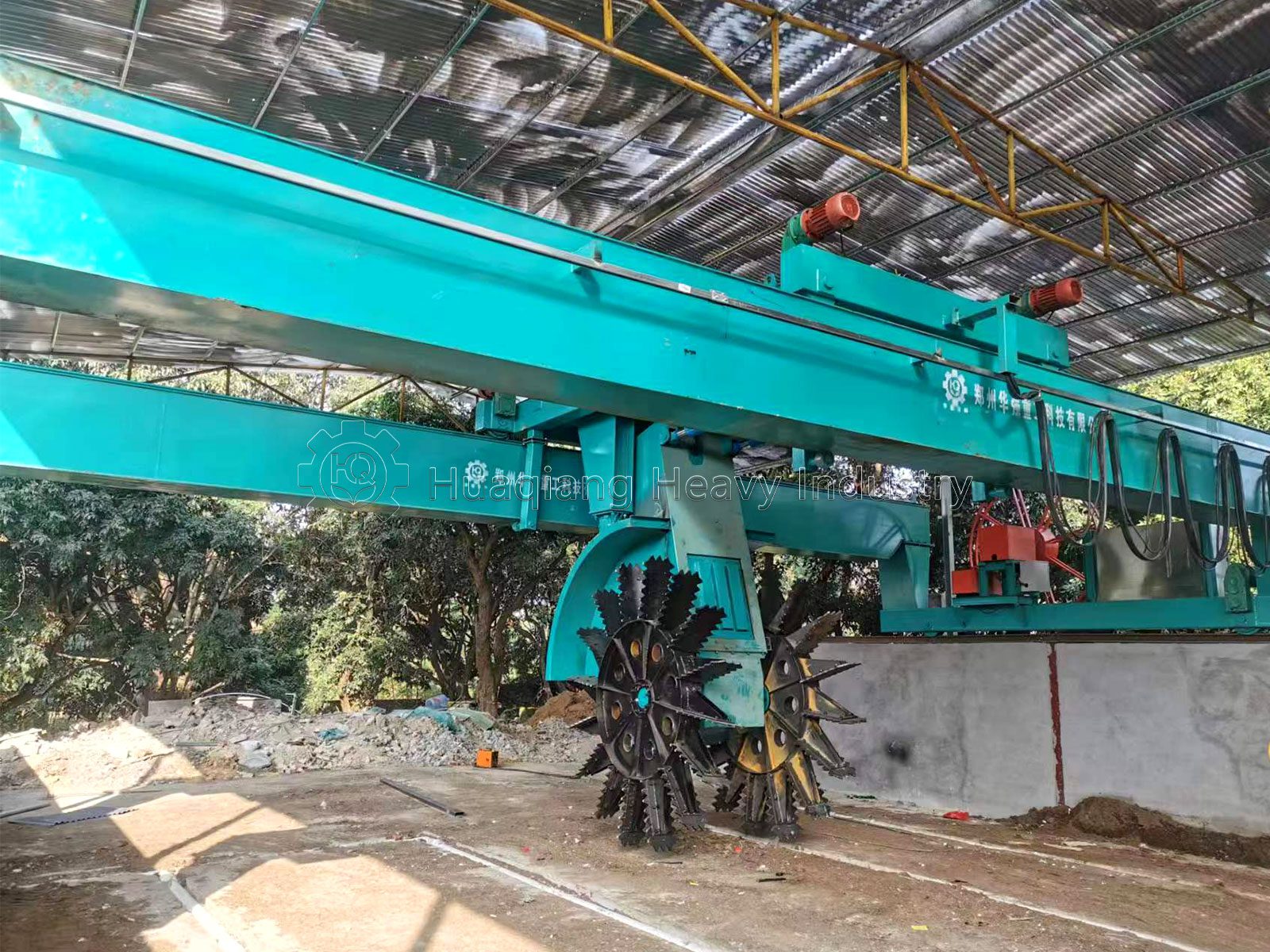

The large wheel compost turning machine is fixed on the tracks of the fermentation tank. It relies on a trolley moving longitudinally and a turntable rotating laterally to turn the material. Mechanical agitation achieves material crushing, displacement, and oxygenation, making it the mainstream equipment for trough-type organic fertilizer fermentation.
The machine consists of a traveling trolley, a rotating disc, suspended rake teeth, a lifting mechanism, and a drive system. The fertilizer compost production machine moves longitudinally at a uniform speed along the steel rails on both sides of the fermentation tank, while the giant disc below rotates synchronously. The disc is densely covered with wear-resistant rake teeth that penetrate deep into the material pile to cut and break up the material. As the disc rotates, it turns over the bottom layer of material, throwing it backward and upward. The oxygen-deficient bottom layer is brought to the surface to come into contact with air, achieving oxygen supply and heat dissipation, accelerating decomposition.
The lifting cylinder can adjust the depth of the rake teeth, allowing for a turning depth of 1.2–2.2 meters depending on the pile height. The trolley moves slowly forward in conjunction with the continuous turning of the disc, gradually shifting the material along the entire tank backward. The fermented material gradually moves forward along the tank and is discharged, achieving continuous fermentation production. During operation, the rake teeth tear and break up clumps of manure, breaking up the anaerobic layer and promptly releasing odorous gases such as ammonia and hydrogen sulfide, thus shortening the fermentation cycle. The moisture content of the raw materials is controlled at 55%–68%. For wet, sticky materials, the walking speed is reduced to prevent material from sticking to the teeth.
Key points for daily management: The walking speed should be controlled at 3–6 m/min; excessive speed will result in incomplete turning. Regularly inspect the rake teeth for wear; shortened teeth will cause material to remain at the bottom for anaerobic digestion. The track should be kept flat and free of debris to prevent the trolley from deviating and causing localized missed turning. Compared to tracked systems, the trough-type large-disc system offers higher site utilization and greater automation, making it suitable for large-scale continuous fermentation production lines.