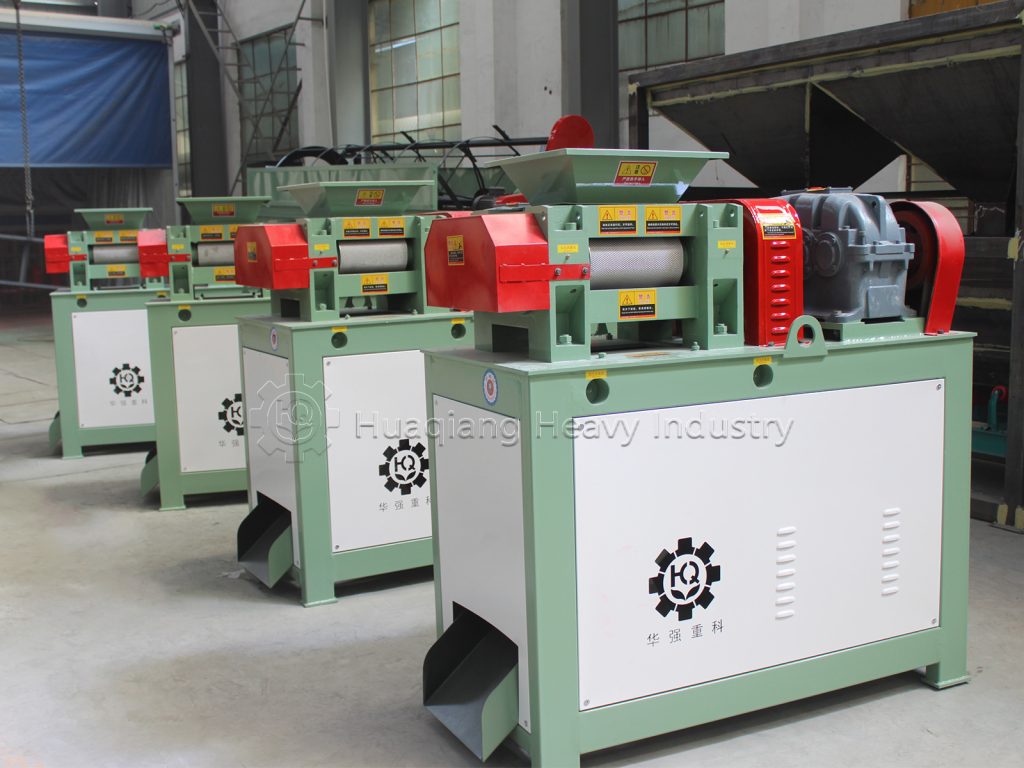

The double roller press granulator is a core piece of equipment for organic fertilizer production that operates at ambient temperature without the need for drying. Thanks to its simple process, low energy consumption, and consistent granulation results, it is widely used in the production of organic and compound fertilizers. To provide a comprehensive understanding of its process characteristics, operational essentials, and application scenarios, we have compiled the following frequently asked questions and answers covering key aspects of the technology.
I. Questions Regarding Basic Process Principles and Core FeaturesQ1: What is the core principle of the double-roller extrusion granulation process?
A: The core principle involves using a pair of counter-rotating extrusion rollers to forcibly compress pre-treated organic, inorganic, or mixed materials into dense sheets (or “cakes”) under high pressure. These sheets are subsequently crushed and screened to produce granular fertilizer that meets specifications. The entire process requires no binders or drying; agglomeration and granulation are achieved through the material’s inherent binding properties and the applied extrusion force, making it a physical granulation process.
Q2: What are the key advantages of the double-roller extrusion granulation process compared to disc granulation or drum granulation?
A: Compared to other granulation methods, this process offers significant advantages: First, it eliminates the need for drying; ambient-temperature granulation saves on equipment investment and energy consumption, thereby reducing production costs. Second, the process flow is streamlined; by omitting the drying stage, the production line layout is simplified. Third, it demonstrates strong material adaptability, capable of processing materials with lower moisture content and handling organic, inorganic, and compound materials. Fourth, the resulting granules possess high strength and resistance to breakage, facilitating storage and transport. Fifth, it generates no dust or wastewater discharge, meeting environmental protection standards.
Q3: What is the scope of application for the double-roller extrusion granulation process, and what types of fertilizers can be produced?
A: This process has a wide range of applications. It can process organic materials such as livestock and poultry manure, crop straw, mushroom residue, and humic acid; inorganic fertilizers like urea, ammonium phosphate, and potassium chloride; as well as organic-inorganic compound materials. It is capable of producing various fertilizers, including pure organic fertilizer, bio-organic fertilizer, compound fertilizer, blended fertilizer, and slow-release fertilizer; the finished granules are suitable for applications such as field crop cultivation, fruit and vegetable growing, and landscaping.
II. Process Flow and Operational Key Points
Q4: What are the stages involved in the complete double-roller extrusion granulation process?
A: The complete process comprises five core stages: raw material pretreatment, ingredient mixing, extrusion granulation, crushing and screening, and finished product packaging. First, raw materials undergo pretreatment involving fermentation, crushing, and impurity removal. Next, different materials are mixed and blended according to the formula ratios. Then, the mixture is fed into the granulator, where extrusion rollers press it into material cakes. These cakes are subsequently crushed, and a screening machine separates the qualified granules. Finally, the qualified granules are weighed and packaged for storage, while unqualified granules are returned to the granulation stage for reprocessing.
Q5: What are the key requirements for the raw material pretreatment stage in the double-roller extrusion granulation process?
A: Raw material pretreatment is fundamental to ensuring effective granulation and must meet three requirements: First, organic materials must be fully fermented and decomposed to prevent heat generation and spoilage after granulation and to enhance material cohesiveness. Second, all materials must be crushed to a particle size of less than 3mm to ensure uniform mixing and prevent large lumps from damaging the extrusion rollers. Third, the material moisture content must be controlled between 10% and 20%; excessive moisture causes materials to stick to the rollers and impedes discharge, while insufficient moisture makes extrusion difficult and reduces the granule formation rate.
Q6: What core process parameters must be mastered when operating the double-roller extrusion granulator?
A: There are three key process parameters: first, the extrusion roll speed, typically controlled at 15–30 rpm; excessive speed leads to insufficient material compaction, while speed that is too slow reduces production efficiency. Second, the roll gap, which must be adjusted based on the target granule size—usually maintained between 0.5 mm and 2 mm; an excessive gap results in loose granules, while a gap that is too small risks damaging the roll surfaces. Third, the feed rate; feeding must be uniform and stable to prevent equipment clogging caused by overfeeding or wear on the rolls caused by idling due to underfeeding.
Q7: What operational precautions should be taken during the crushing and screening stages of the double-roll extrusion granulation process?
A: In the crushing stage, the crusher speed must be adjusted according to the hardness of the material cake to avoid over-crushing (resulting in excessively fine granules) or under-crushing (leaving large chunks of cake). In the screening stage, the screen mesh size must match the target granule size—typically 2–6 mm—and material should be fed uniformly during operation to prevent accumulation and screen clogging. Additionally, off-spec granules must be promptly collected and returned to the granulator for re-extrusion to minimize material waste and ensure a high product pass rate.
III. Equipment Suitability and Process Optimization
Q8: How does production capacity differ among various models of double-roll extrusion granulators?
A: Granulator capacity is primarily determined by roll diameter and length. Small-scale granulators (roll diameter 200–300 mm) have an hourly output of 0.3–1 ton, making them suitable for small organic fertilizer workshops or laboratories. Medium-sized equipment (roll diameter 300–500 mm) produces 1–3 tons per hour, catering to small-to-medium organic fertilizer enterprises. Large-scale equipment (roll diameter >500 mm) produces 3–8 tons per hour, meeting the needs of large-scale, continuous production; some customized models can exceed 10 tons per hour.
Q9: How can the process be optimized if granules produced via double-roll extrusion granulation have uneven particle sizes or insufficient strength?
A: Uneven particle size can be addressed in two ways: first, by adjusting the roll gap to ensure uniformity; and second, by optimizing raw material pretreatment to ensure consistent particle size and thorough mixing. Insufficient granule strength is primarily caused by unsuitable material moisture content or inadequate extrusion pressure. To address this, adjust the material moisture content to an optimal range and increase the extrusion roller pressure; additionally, inspect the rollers for wear and promptly repair or replace worn surfaces to improve extrusion performance.
Q10: Which processes can be integrated with roller extrusion granulation to enhance production efficiency?
A: This process can be integrated with automated batching and mixing systems to achieve precise material ratios and uniform mixing, thereby improving granulation consistency. It can also link with intelligent screening and packaging systems to automate the screening, weighing, and packaging of finished products, reducing manual labor. For bio-organic fertilizer production, a microbial agent addition step can be incorporated during mixing to ensure even dispersion. If slow-release fertilizer is required, a coating process can be added after granulation to enhance the slow-release effect.
IV. Process Maintenance and Troubleshooting
Q11: What problems commonly occur during the operation of the roller extrusion granulation process, and how can they be prevented?
A: Common issues include material sticking to the rollers, roller wear, and equipment clogging. Preventive measures include: strictly controlling material moisture content to prevent sticking; thoroughly removing hard impurities during raw material pretreatment to avoid damaging roller surfaces; ensuring uniform feeding to prevent overloading and clogging; and regularly lubricating transmission components and checking the gap between extrusion rollers for timely adjustment and maintenance.
Q12: What are the key tasks for the daily maintenance of the roller extrusion granulation process?
A: Daily maintenance involves three main tasks: promptly clearing residual material from the granulator after operation to prevent caking that could affect future runs; regularly inspecting extrusion roller surfaces for wear or cracks, and performing build-up welding repairs or replacements when wear is severe; and monitoring the operating status of the transmission system and bearings—applying lubricant every 7 days and conducting a comprehensive equipment overhaul every 30 days to ensure stable operation.
Q13: What opportunities exist to optimize the roller extrusion granulation process regarding environmental protection and cost control?
A: Regarding environmental protection, bag-type dust collectors can be installed during the raw material crushing and screening stages to reduce dust emissions; furthermore, all off-spec granules generated during production can be recycled, achieving zero material waste. In terms of cost control, the pass rate of finished products can be improved and material loss reduced by optimizing raw material ratios and precisely controlling process parameters; labor input can be minimized through automated controls; and energy consumption and maintenance costs can be lowered by selecting appropriate equipment models and avoiding equipment overload.
In summary, the double-roll extrusion granulation process has become a mainstream method for organic fertilizer production due to advantages such as the elimination of drying steps, low energy consumption, and process simplicity. In practical application, achieving efficient, stable, and eco-friendly production—and manufacturing high-quality granular fertilizers that meet standards—requires strict control over key stages like raw material pretreatment, process parameter adjustment, and equipment maintenance, alongside the optimization of process configurations based on production needs.