

In the organic fertilizer production chain, fermentation turning and precise ingredient mixing are two of the most easily underestimated stages. The former determines whether the material is “cooked,” and the latter determines whether the product is “stable.” Many factories spend a lot of money on granulation equipment, but repeatedly encounter problems in these two stages—incomplete fermentation leads to granulation sticking to the mold, and inaccurate ingredient mixing leads to excessive nutrients in the entire batch. The following analyzes how to overcome these bottlenecks from two dimensions: the selection of compost turning equipment and the precision of the ingredient mixing system.
How to choose compost turning equipment? It depends on the fermentation scenario.
The core tasks of a compost turning machine are turning, stirring, and aeration, but different scenarios have drastically different requirements for the equipment.
A hydraulic compost turning machine uses a hydraulic drive system, offering a large turning depth and high precision, suitable for trough-type aerobic fermentation. Trough fermentation demands higher standards for turning uniformity and oxygen supply, and hydraulic compost turners can more precisely control the turning depth. Its advantages include: the hydraulic system has built-in overload protection and automatically releases pressure when encountering hard objects, reducing the risk of equipment damage. The disadvantage is that hydraulic transmission has a 15%-30% power loss, resulting in slightly higher energy consumption.
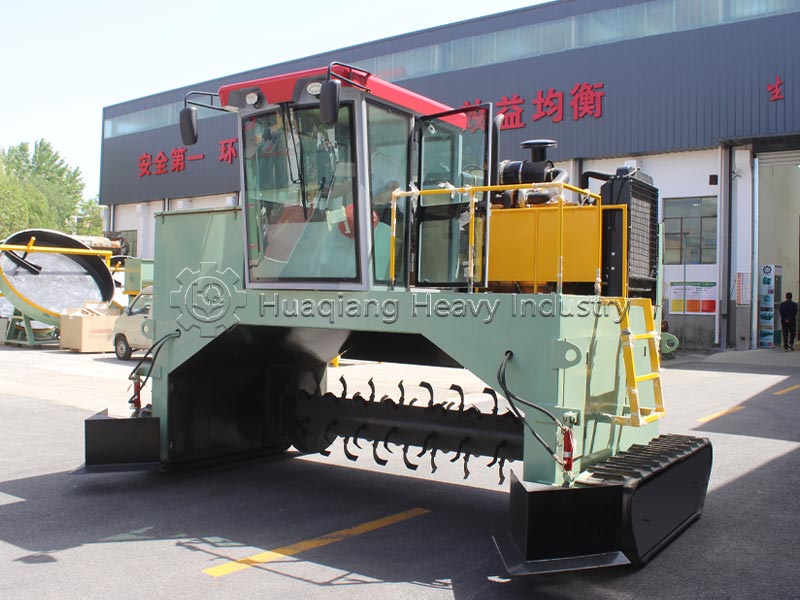
Windrow compost turning machines use a tracked walking system, offering strong ground adaptability and suitability for uneven or soft ground. Windrow fermentation does not require the construction of fermentation tanks, resulting in lower equipment investment and greater flexibility. However, the turning depth and uniformity are not as good as trough equipment, making it suitable for small to medium-scale production.
Large wheel compost turning machines are ideal for large-scale production. The turning wheel diameter can reach 1.5-2.5 meters, and a single unit can process 200-800 tons of material per hour, with a maximum daily processing capacity of nearly 20,000 tons. Equipped with an intelligent electronic control system, it supports constant speed cruise and automatic obstacle avoidance. It is suitable for large organic fertilizer plants with an annual output of over 10,000 tons. When choosing a compost turner, three key factors should be considered: daily processing capacity, fermentation tank type (trough or windrow), and budget. Choosing the wrong machine can extend the fermentation cycle from 7-10 days to 45 days, causing the entire production line to wait.