

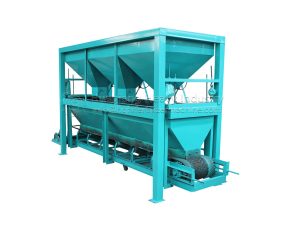
In a BB fertilizer production line, the multiple-silo single-weigh static batching system acts as the guardian of accuracy. This system utilizes multiple silos to store different raw materials, discharging them sequentially into a single high-precision weigh hopper based on recipe instructions; weighing occurs while the material is relatively stationary, allowing batching accuracy to be controlled within ±0.2%. However, a frequently overlooked fact is that the upper limit of batching accuracy is not determined solely by the scale itself, but is largely pre-conditioned by the compost turner operating in the fermentation tank. For a BB fertilizer production line, the coefficient of variation for mixing uniformity must remain stable below 5%, and the granule breakage rate must be under 1%; achieving these metrics depends first on whether the material entering the batching system possesses stable physical properties.
The “invisible control” that compost turners exert over batching accuracy operates primarily through two mechanisms. The first concerns the spatial uniformity of moisture content. When material in a fermentation tank remains undisturbed for extended periods, the bottom layer (approximately 30 cm deep) becomes compacted by gravity, creating a high-moisture zone where the moisture content is 10% to 15% higher than at the surface. When this material—dry on top and wet at the bottom—enters the batching system, it causes fluctuations in feed rates: dry material flows freely and discharges quickly, whereas wet material is viscous and discharges slowly. Consequently, even with highly accurate load cells, this feeding instability introduces errors at the source. Periodic turning by a hydraulic compost turner (or fermentation compost turner) is designed specifically to eliminate these spatial disparities. A wheel-type compost turner, for instance, can operate across widths of 4 to 12 meters and depths of 1.5 to 2 meters; a single pass thoroughly turns the bottom material to the surface, compressing the moisture content variance across the entire tank to within 3%. For the mixing uniformity of a BB fertilizer mixer to remain stable (with a coefficient of variation below 5%), a prerequisite is that the granular components entering the mixer have roughly consistent moisture content.
The second factor is the uniformity of the material’s degree of decomposition. Residual cellulose and hemicellulose in incompletely decomposed organic matter continue to break down slowly after entering the batching system, causing the material’s bulk density and flow characteristics to change over time. This means that for the same formula, 100 kg of decomposed material weighed today may differ in volume and feeding characteristics from 100 kg weighed a week later. Large-wheel compost turning machines achieve superior oxygenation efficiency compared to static fermentation by repeatedly tossing material into the air; this shortens the fermentation cycle from the traditional 45 days to 20–25 days and boosts decomposition uniformity to over 95%. The more uniform the decomposition, the more stable the material’s physical properties, and the more reliable the weighing accuracy of the multiple-silo, single-weigh static batching system.