

When a fertilizer plant receives two vastly different types of orders, the choice of production line becomes an exercise in economics. One scenario involves “small batches and multiple formulas”—for instance, a cooperative needs 20 tons of specialized rice fertilizer while another farm requires 15 tons of high-nitrogen vegetable fertilizer; the formulas differ, and the delivery deadline is tight (just three days). The other scenario involves “large batches and a single formula”—such as a distributor ordering 500 tons of 15-15-15 general-purpose fertilizer in one go, requiring high granule strength to withstand long-distance transport and repeated loading and unloading. The former tests economies of scope, while the latter tests economies of scale. The NPK bulk blending line and the extrusion granulation process (centered on the double-roller press granulator) correspond precisely to these two distinct profitability models, with the NPK bulk blending machine serving as the core implementer of the former.
The essence of economies of scope lies in “producing multiple products using the same set of equipment.” A blending line achieves this because it does not alter the chemical form of the raw materials, relying instead on physical mixing. The NPK bulk blending machine utilizes a multi-bin static weighing structure; each raw material is weighed individually before being discharged together. By employing variable frequency drives to control “fast” and “slow” feeding modes, the proportioning error can be kept within ±0.2%. The mixing stage uses a low-speed, twin-shaft paddle system to create a convective flow, causing granules of varying bulk densities to repeatedly exchange positions, resulting in a mixing uniformity coefficient of variation consistently below 5%. The entire production line eliminates the need for granulation, drying, or cooling; switching from producing 28-6-6 rice fertilizer today to 15-15-15 general-purpose fertilizer tomorrow requires only a few numerical adjustments in the control system, with no physical modifications needed to the equipment itself. This “adjust-and-go” capability allows blending stations to meet the personalized needs of nearby farms with minimal inventory costs, generating profit through formulation services and rapid response times.
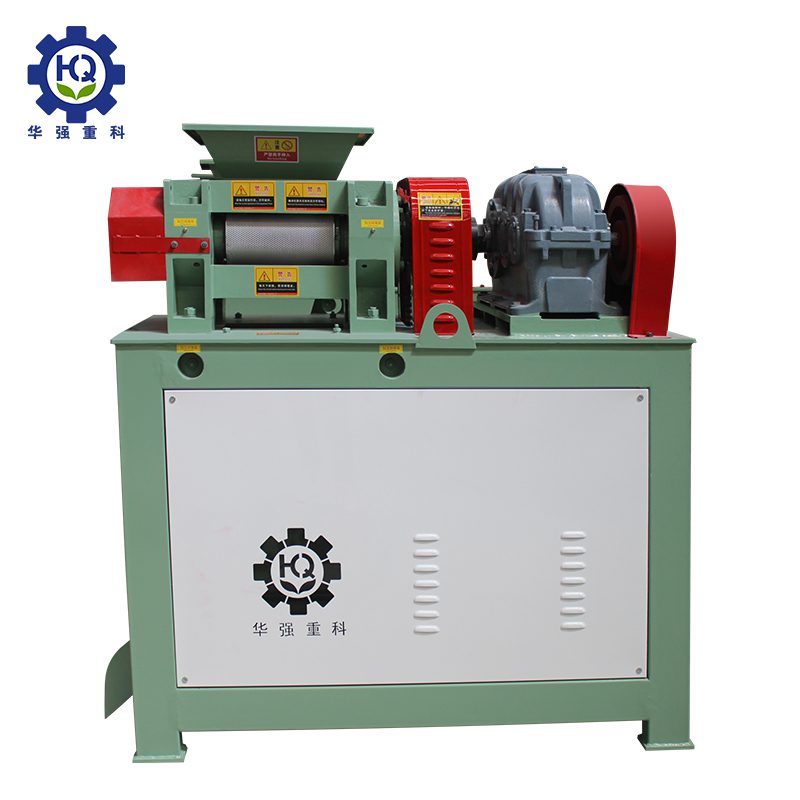
The logic behind economies of scale is entirely different. Double-roller press granulators are designed for the continuous, high-volume production of single-formula products. Two counter-rotating, high-strength rollers compress dry powder—with a moisture content of no more than 5%—into dense sheets at ambient temperature. The bonding between particles relies on natural molecular-level attractions such as van der Waals forces, adsorption, and crystal bridging; the entire process requires neither added water nor heat generation. This dry processing route eliminates the drying and cooling systems essential to wet granulation, reducing overall energy consumption by 30% to 50% compared to wet processes. The resulting granules are dense and robust, achieving a compressive strength exceeding 20 N after 24 hours of curing, with negligible dusting or breakage during loading, transport, and multi-layer stacking. For compound fertilizers destined for national markets and long-distance transport, such high-strength granules translate to lower breakage rates and fewer customer complaints. The profitability of extrusion lines stems from economies of scale and energy efficiency: once started, they run continuously, spreading fixed costs thinly across each unit of output.
The boundary between these two production routes is not sharply defined. Many large fertilizer enterprises operate both blending lines and extrusion lines: extrusion lines process self-produced or purchased powdered raw materials into granular base materials, while blending lines combine these bases with other finished granules to create customized formulations. Blending lines serve local fertilizer stations and family farms within a 300-kilometer radius, whereas extrusion lines cater to national distributors and export orders. Economies of scope and economies of scale coexist within the same facility, each fulfilling its specific role without interference.
Profitability in fertilizer processing never depends on which production line is “more advanced,” but rather on how well the line aligns with your market reach and order structure. In markets characterized by small batches and diverse formulas, the flexibility of blending lines drives profit; in markets involving high volumes and long-distance transport, the high granule strength and low energy consumption of extrusion lines create a competitive advantage. The first step in equipment selection is not comparing price quotes, but answering a more fundamental question: Who are your customers, how often do they place orders, and what tonnage do they require per order? The answer will determine the right path to take.