

In a fertilizer processing workshop, no single piece of equipment is a “jack-of-all-trades”—each process corresponds to a specific material state and product target. The BB fertilizer production line, fertilizer roller press machine, and hydraulic compost turning machine are like three “specialists,” each with their own unique skills, quietly cultivating their respective fields of blending, molding, and fermentation, without competing with each other, yet indispensable.
The BB fertilizer production line acts as a “courier sorter.” It doesn’t produce new granules; it precisely grabs, weighs, mixes, and packages finished granular fertilizers—urea, diammonium phosphate, potassium chloride, etc.—from all directions according to the order formula, and then ships them out. The core capabilities of this production line lie in two dimensions: first, the precision of ingredient mixing, with multi-compartment static scales accumulating and weighing in batches, ensuring that nutrient deviations in each batch are controlled within a minimal range; second, the gentleness of mixing, with dual-shaft paddles using low-speed convection to allow different particles to fully “join hands” without damaging each other. For fertilizer blending stations that switch between seven or eight formulas daily, this production line is virtually irreplaceable—today it produces rice-specific fertilizer, tomorrow high-nitrogen corn fertilizer, and the day after, it switches to water-soluble fertilizer for vegetables; a few parameter changes in the system allow for seamless production transitions, requiring no physical adjustments to the equipment itself.
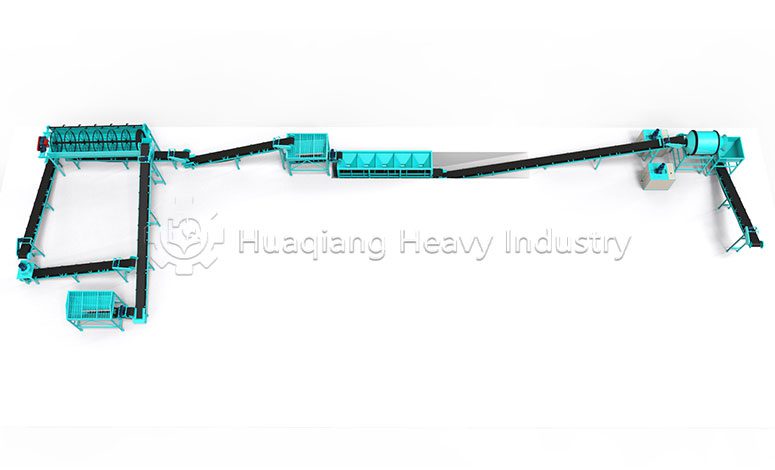
In stark contrast to the “light touch” approach of the BB production line, the fertilizer roller press machine is more like a “heavy-duty craftsman.” Its work involves not finished granules, but rather loose, airy, and commercially worthless powder raw materials. Two high-strength rollers rotate in opposite directions at a pressure of hundreds of megapascals, instantly compressing the powder into a dense cake, which is then crushed and screened to obtain finished granules. The entire process requires no water addition and no temperature change; it relies purely on mechanical pressure to “clump” the powder together. This robust approach is precisely the savior for certain difficult-to-process materials—when the formula contains a large amount of urea, it will deliquesce and stick together when exposed to water; when the material contains low-melting-point components, it will melt and gelatinize when heated. Only the “dry” method of roller extrusion can handle this, transforming formulas that wet granulation and high-tower spraying are helpless into uniform, high-strength granules.
The hydraulic compost turning machine doesn’t even operate in a workshop, but in an open-air fermentation field. Its work involves fresh chicken manure, sticky dehydrated sludge, or chopped straw—materials that are severely oxygen-deficient when piled together, allowing only slow and foul-smelling anaerobic fermentation. The hydraulic compost turning machine periodically cuts into the 1.5-meter-deep pile, turning the oxygen-deficient material at the bottom to the surface and drawing the dried material from the surface into the interior. Each turning is equivalent to giving the entire pile a “lung transplant.” Aerobic microorganisms thus received a continuous supply of oxygen, converting organic matter into stable humic acid. At the same time, the pile temperature rose to over 55°C, naturally killing insect eggs and pathogens. After more than twenty days of turning and turning management, the originally pungent waste was transformed into a handful of loose, dry, and well-rotted organic material, providing qualified raw materials for the next process.