

If you view fertilizer production as a timeline, you’ll find an interesting division of labor: some equipment handles the transformation of the “past,” some shapes the “present,” and some serves the flexible formulation of the “future.” The windrow compost turning machine, Double roller press granulator, and NPK Blending Fertilizer Production Line occupy different points on this timeline, collectively completing a long relay from waste organic matter to precisely formulated fertilizer.
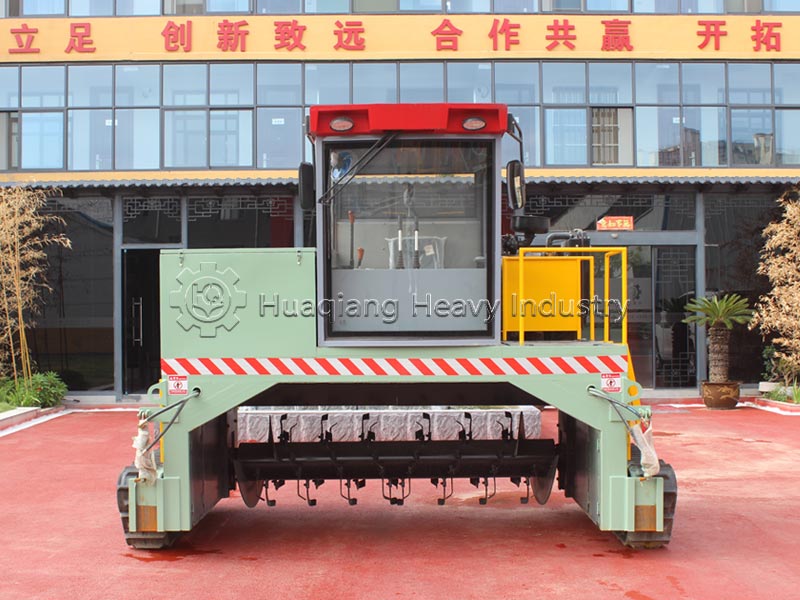
The first leg belongs to the windrow compost turning machine, whose work involves freshly produced, still-raw, animal manure or urban sludge. These materials have high moisture content and a dense structure, with almost zero internal oxygen. Natural stacking would only lead to anaerobic fermentation—producing pungent ammonia and hydrogen sulfide, while the core temperature would never rise, allowing insect eggs and pathogens to survive. The mission of the turner is to periodically “disassemble” these long, narrow piles: its rollers or turning wheels, driven by hydraulic pressure, cut into the pile, turning the bottom material to the surface and the inside to the outside. Each turn is equivalent to replacing the entire pile with aeration. Aerobic microorganisms thus receive a continuous supply of oxygen, decomposing the organic matter into stable humus, while the pile temperature is maintained in a high range of 55°C to 70°C—a temperature sufficient to kill most pathogens and weed seeds. After about three weeks of repeated turning, the originally sticky, foul-smelling waste becomes a handful of loose, dry, well-rotted material with an earthy aroma, completing its transformation from “pollutant” to “raw material.”
The second stage is handled by the Double Roller Press Granulator. Even after composting, organic powders or industrially synthesized nitrogen, phosphorus, and potassium powders meet nutrient content standards, their physical form remains loose, airy, and difficult to measure and store. The role of a roller extrusion granulator is to give these powders a “physical identity card”—using two high-strength rollers rotating in opposite directions, the material is instantly compressed into a thin cake under pressure of hundreds of megapascals, and then crushed and sieved into uniform particles. This process involves no water or heating; it relies purely on external force to compress the powder particles closer together, allowing intermolecular forces to naturally “join hands.” The extruded particles have high density and strength, and will not easily pulverize during subsequent packaging, transportation, and mechanical dispersal. More importantly, this dry process is particularly suitable for special formulations that are prone to deliquescence when exposed to water or melting when heated, broadening the range of materials that can be processed.
Finally, the NPK Blending Fertilizer Production Line takes a completely “flexible formulation” approach. It no longer modifies the form of materials, but instead precisely weighs and rapidly mixes pre-formed granular fertilizers—whether extruded or purchased urea or diammonium phosphate granules—according to soil testing and formulation. The core of this production line lies in the precision of the batching process. Multi-compartment static scales weigh each batch in batches to ensure that the nitrogen, phosphorus, and potassium ratios strictly meet design requirements, followed by gentle mixing to achieve uniform distribution. Its value lies in its ability to quickly respond to formulation changes for different customers and plots, seamlessly switching between small-batch customization and large-order continuous production.