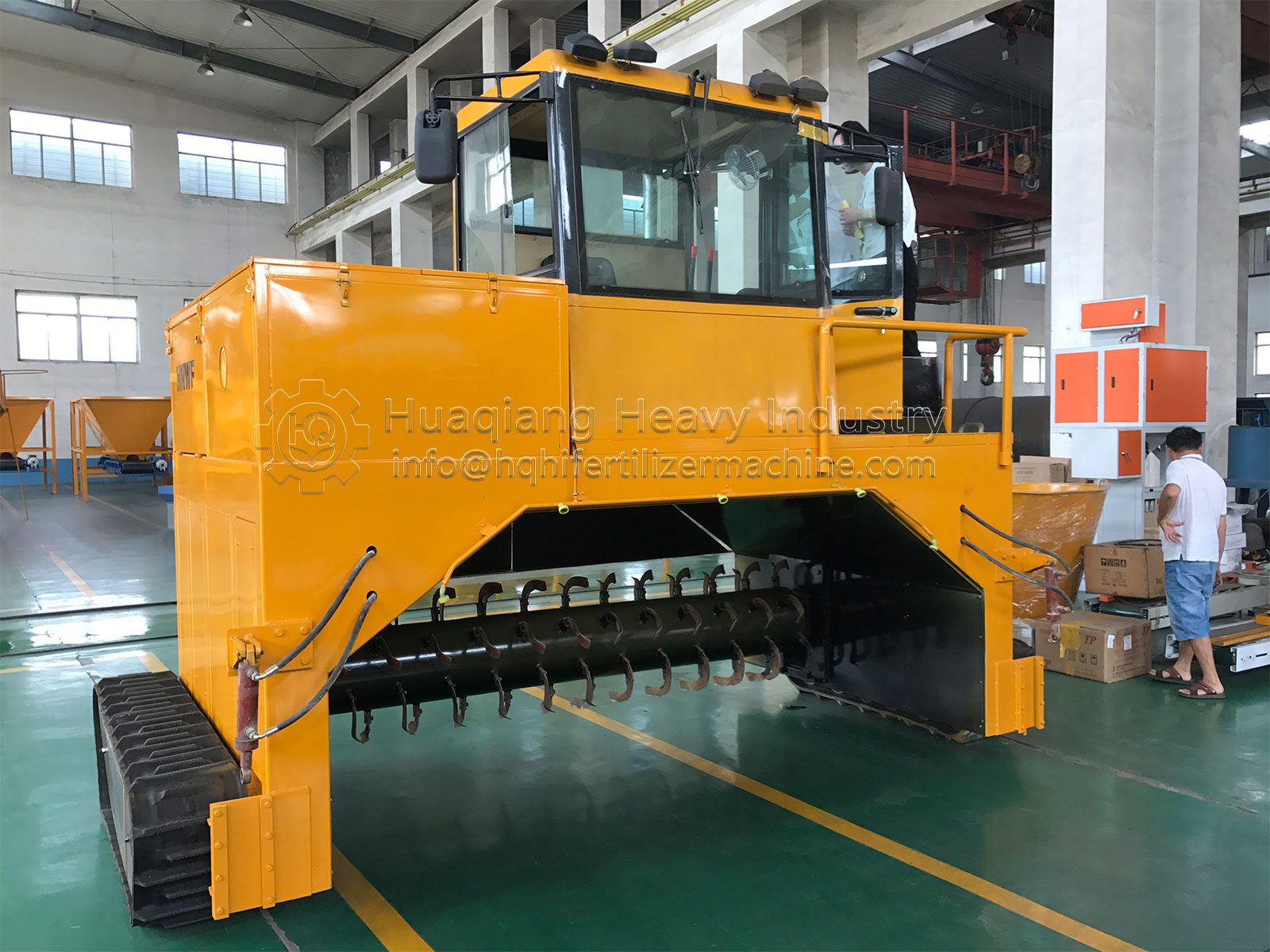

Insufficient uniformity in compost turning with windrow compost turning machines can easily lead to localized anaerobic digestion, uneven fermentation, and incomplete deodorization. Improvement can be achieved through optimization in four aspects: equipment debugging, operational standards, material pretreatment, and daily maintenance.
First, optimize equipment parameters and structural debugging. Adjust the lifting height of the turning drum according to the height and width of the material pile, ensuring the teeth penetrate the bottom of the pile to prevent surface turning and bottom stagnation. Set the travel speed appropriately; too high a speed will result in insufficient material dispersion, while too slow a speed will cause accumulation. A standard speed is 4–8 meters per minute. Adjust the drum speed; too low a speed will result in poor mixing, while too high a speed will cause dust generation. Match the speed to the material moisture content. Inspect the spiral blades and teeth to ensure they are intact, without deformation, and with consistent spacing. Replace any severely worn parts promptly to ensure smooth material gathering, dispersing, and scattering.
Second, standardize on-site operations. Maintain a regular pile shape with uniform width and height, avoiding excessive differences in width and height. A staggered, reciprocating operation is employed, with slight overlap between adjacent work areas to eliminate blind spots in the turning process. Each turning operation is thorough, avoiding simplification of procedures. During the high-temperature fermentation stage, the frequency of turning can be increased to further break up clumps of material.
Proper pre-treatment of materials is fundamental. Long-fiber materials such as straw and vines should be crushed in advance to prevent them from entangled in the drums and hindering turning. The material ratio should be uniform, with a moisture content controlled between 55% and 65%. Excessive moisture content results in sticky, clumpy materials that are difficult to break up; insufficient moisture content leads to loose materials and reduced mixing efficiency.
Finally, routine maintenance is crucial. After each operation, clean the drums and blades of any sticky material and entangled debris to prevent accumulation from altering the turning trajectory. Regularly inspect the tracks and hydraulic system to ensure smooth, stable, and vibration-free movement, preventing machine swaying that could cause turning deviation. After long-term use, calibrate the drum coaxiality to ensure stable operation and maintain consistently high turning uniformity.