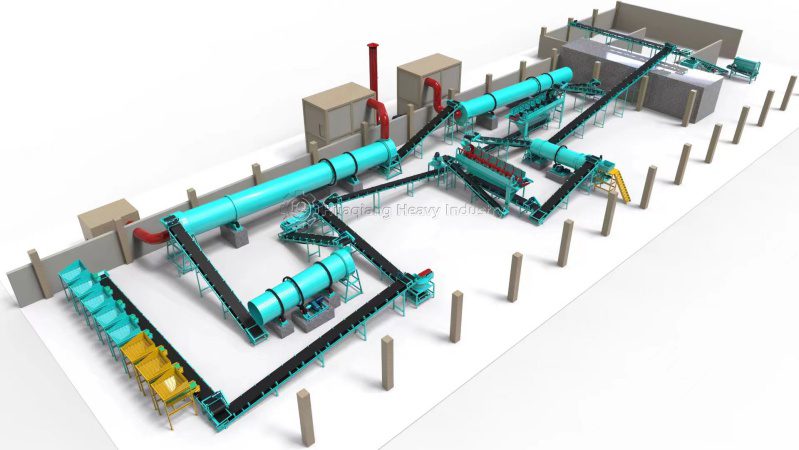

NPK blending fertilizer production lines rely on continuous operations of batching, conveying, mixing, screening, and packaging. Standardized operation is crucial throughout the process to ensure accurate proportions, stable production, and equipment durability.
Before starting the machine, conduct a thorough start-up inspection. Check the motors, reducers, belt conveyors, and bearings of all equipment to ensure they are in good working order. Clean out any debris, clumps of raw materials, and metal impurities from inside the equipment to prevent jamming and damage to parts. Simultaneously calibrate the automatic batching scale to ensure accurate NPK proportions and prevent substandard nutrient content, which is core to the quality of blended fertilizer.
During production, strictly control the uniformity of raw material particle size. The size and specific gravity of different raw material particles should not differ excessively; otherwise, stratification and segregation are likely to occur after mixing, resulting in uneven nutrient content in the finished product. Feeding should be uniform and even; overloading the machine with sudden feeding is strictly prohibited to prevent mixer blockage and belt misalignment/tearing. Monitor the mixing time constantly; too short a time will result in uneven mixing, while too long a time will cause particle breakage and pulverization.
During daily operation, pay close attention to the condition of the NPK blending machine. Observe the equipment for any abnormal noises, vibrations, excessive bearing temperature, and belt slippage or misalignment. Maintain a dry and well-ventilated workshop environment to prevent raw materials from absorbing moisture and clumping, which also reduces equipment corrosion. When switching between different raw material formulations, thoroughly clean the machine to avoid cross-contamination and affecting formula purity.
After production, promptly stop the machine and clean it. Remove any residual material from the mixer and conveyor equipment to prevent moisture absorption, clumping, and corrosion. Simultaneously, ensure proper lubrication and maintenance of all transmission components to extend the service life of the entire production line.