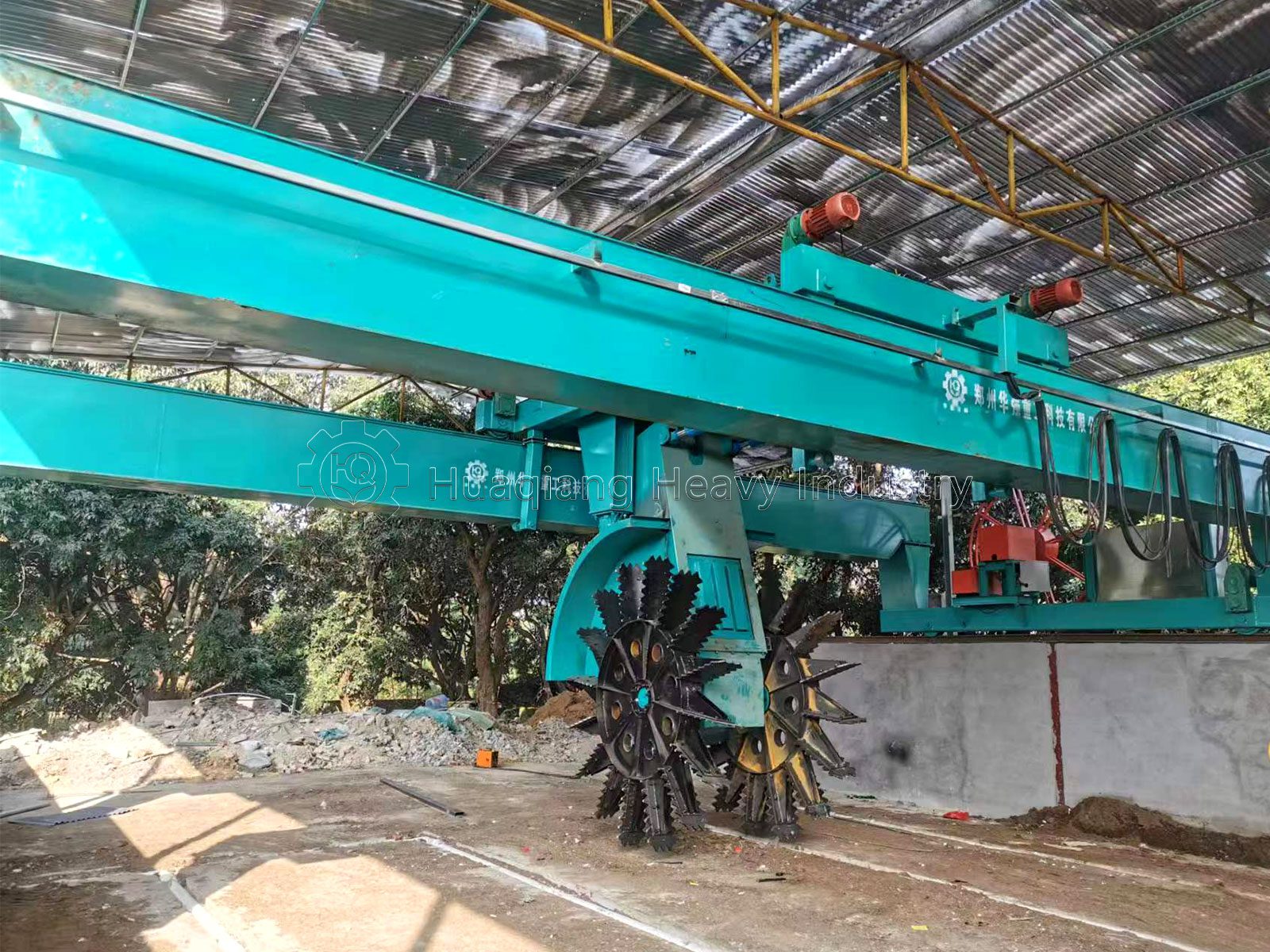

The core of selecting the size of a large wheel compost turning machine revolves around five dimensions: fermentation tank span, fermentation depth, daily processing capacity, raw material characteristics, and plant site conditions. Dimensions include four key parameters: overall machine span, disc diameter, lifting stroke, and overall length, width, and height. Improper selection can lead to problems such as dead corners during turning, motor burnout due to overload, and incomplete material turning.
First, determine the overall machine span based on the fermentation tank width; this is the primary selection criterion. Small and medium-sized organic fertilizer plants typically have a single tank width of 6-8 meters, requiring an 8-meter span disc compost turner. Large-scale plants with a single tank width of 10-15 meters require 12/15-meter large span models. Large centralized processing plants with multiple tanks can choose 20-30 meter ultra-large span equipment.
Second, match the disc diameter and lifting stroke based on the pile height. For standard livestock and poultry manure piles, a height of 1.6-2 meters is recommended, using a standard wheel with a diameter of 1.8-2.2 meters. For plants processing thousands of tons per day, a pile height of 2.5-3 meters is recommended, using a large-diameter wheel with a 2.5-3 meter diameter, with a hydraulic lifting stroke synchronized to 3.2 meters. The wheel diameter determines the turning depth; a smaller diameter will fail to break up the compacted material at the bottom, resulting in uneven oxygen supply to the pile; a larger diameter increases the overall weight of the machine, doubles the load on the rails and motors, and increases energy consumption and component wear.
Finally, the dimensions of the plant and track area must be matched. The net width and height of the fermentation area within the plant should allow for equipment maintenance space. The track length should be adapted to the total length of the fermentation tank, with at least 5 meters of relocation space at each end of the machine. For open-air fermentation sites, extra-large span models can be used. In indoor workshops, due to height limitations, the wheel diameter should not exceed 2.5 meters to avoid interference from the roof beams. The dimensions are determined by considering the tank, production capacity, and site conditions, while also taking into account fermentation effect, energy consumption, and the service life of the fermentation compost turning machine.